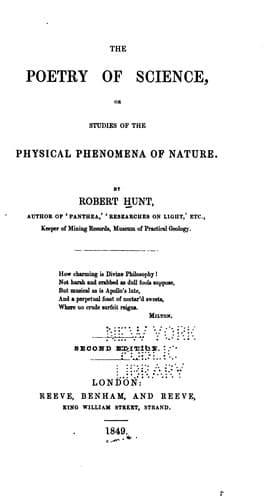
The Poetry of Science; or, Studies of the Physical Phenomena of NatureHunt, Robert
Philosophy
The Poetry of Science; or, Studies of the Physical Phenomena of Nature
Hunt, Robert
Physics; Science
set spinning obliquely, it will be seen that the axis will continue
to point along the line it took at the commencement of motion. By
placing a heavy sphere in a lathe, resting its projecting axial points
on some moveable bearings, and then getting the sphere into extremely
rapid motion, one of the bearings may be removed without the mass
falling to the ground. The rapidity of motion changes so constantly and
quickly the position of the particles which have a tendency to fall,
that we have motion balanced against the force of gravitation in a
striking manner; and we learn, from this experiment, the explanation
of the planetary and stellar masses revolving on their axis at a speed
sufficient to maintain them without support in space. A mass of matter,
a sphere or a disc, carefully balanced, is fixed in gymbals such as we
employ for fixing our compass needles, and it is set by some mechanical
contrivance in rapid rotation. The position of the axis of rotation
remains unaltered, although the earth is moving; and thus, by this
instrument,--called the gyroscope,--we can determine, as with the
pendulum, the motion of the earth around its axis; and we learn why,
during its movement around the sun, its axis is undeviatingly pointed
towards one point in space, marked in our Heavens as the Polar Star.
In addition to these great rotations, the earth is subjected to other
motions, as the precession of the equinoxes and the nutation of its
axis. Rocking regularly upon a point round which it rapidly revolves,
whilst it progresses onward in its orbit, like some huge top in
tremulous gyration upon the deck of a vast aërial ship gliding rapidly
through space, is the earth performing its part in the great law of
motion.
The rapidity of these impulses, supposing the powers of the physical
forces were for a moment suspended, would be sufficient to scatter the
mass of our planet over space as a mere star-dust.
Limiting, as much as possible, the view which opens upon the mind as we
contemplate the adjustments by which this great machine, our system, is
preserved in all its order and beauty, let us forget the great movement
of the whole through space, and endeavour to consider the effect of
those motions which are directly related to the earth, as a member of
one small group of worlds.
We cannot for a moment doubt, although we have not any experimental
proof of the fact, that the proper motions of the earth materially
influence the conditions of the matter of which it is formed. Every
pair of atoms is, like a balance, delicately suspended, under the
constant struggle which arises from the tendency to fly asunder,
induced by one order of forces--centrifugal force--and the efforts of
others, gravitation and cohesion, to chain them together. The spring is
brought to the highest state of tension--one tremor more, and it would
be destroyed.
Public-domain text, read in full here on John Shaqi.
Reviews
Reviews
No reviews yet
Be the first to share your thoughts on this work.
Join the Discussion
Join the discussion
Sign in to leave a comment or review.
Sign InorCreate an account