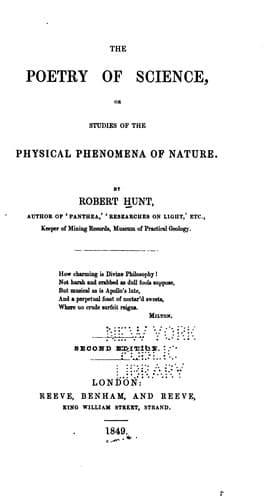
The Poetry of Science; or, Studies of the Physical Phenomena of NatureHunt, Robert
Philosophy
The Poetry of Science; or, Studies of the Physical Phenomena of Nature
Hunt, Robert
Physics; Science
We cannot, by any comparison with the labours of the most skilful human
artisan, convey an idea of the exquisite perfection of planetary
mechanics, even so far as they have been discovered by the labours of
science; and we must admit that our insight into the vast machinery has
been very limited.
All we know is the fact that this planet moves in a certain order, and
at a fixed rate, and that the speed is of itself sufficient to rend
the hardest rocks; yet the delicate down which rests so lightly upon
the flower is undisturbed. It is, therefore, evident that matter is
endued with powers, by which mass is bound to mass, and atom to atom;
these powers are not the results of any of the motions which we have
examined, but, acting in antagonism to them, they sustain our globe in
its present form.
Are there other motions to which these powers can be referred? We
know of none. That absolute rest may not exist among the particles of
matter is probable. Electrical action, chemical power, crystalline
aggregation, the expansive force of heat, and many other known
agencies, are in constant operation to prevent it. It must, however,
be remembered, that each and every atom constituting a mass may be
so suspended between the balanced forces, that it may be regarded as
relatively at rest.
Theory imagines Motion as producing Force--a body is moved, and its
mere mechanical change of place is regarded as generating heat; and
hence the refinements of modern science have advanced to the conclusion
that motion and heat are convertible. Admitting that the material atoms
of which this world is formed are never in a state of quiescence, yet
we cannot suppose any gross ponderable particle as capable of moving
itself; but once set in motion, it may become the secondary cause of
motion in other particles.[10] The difficulties of the case would
appear to have been as follows:--Are heat, light, electricity, &c.,
material bodies? If they are material bodies--and heat, for example, is
the cause of motion--must not the calorific matter move itself--or if
it be not self-moving, by what is it moved? If heat is material, and
the primary cause of motion, then matter must have an innate power of
moving; it can convert itself into active force, or be at once a cause
and an effect, which can scarcely be regarded as a logical deduction.
We move a particle of matter, and heat is manifested; the force being
continued, light, electricity, and chemical action result; all,
as appears from a limited view of the phenomena, arising out of
the mechanical force applied to the particle first moved.[11] This
mechanical force, it must be remembered, is external to the body moved,
and is, in all probability, set up by the movement of a muscle, acted
upon by nerves, under the influence of a will.
Public-domain text, read in full here on John Shaqi.
Reviews
Reviews
No reviews yet
Be the first to share your thoughts on this work.
Join the Discussion
Join the discussion
Sign in to leave a comment or review.
Sign InorCreate an account