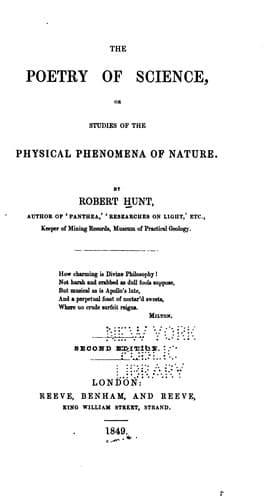
The Poetry of Science; or, Studies of the Physical Phenomena of Nature — John Shaqi
The Poetry of Science; or, Studies of the Physical Phenomena of NatureHunt, Robert
Philosophy
The Poetry of Science; or, Studies of the Physical Phenomena of Nature
Hunt, Robert
Physics; Science
The series of phenomena we have supposed to arise admit of an
explanation free of the hypothesis of motion, and we avoid the
dangerous ground of metaphysical speculation, and the subtleties of
that logic which rests upon the immateriality of all creation. This
explanation, it is freely admitted, is incomplete: we cannot distinctly
correlate each feature of the phenomena, combine link to link, and thus
form a perfect chain; but it is sufficiently clear to exhibit what we
do know, and leave the unknown free for unbiassed investigation.
Each particle, each atom of that which conveys to our senses the only
ideas we have of natural objects--ponderable matter--is involved
in, or interpenetrated by, those principles which we call heat and
electricity, with probably many others which are unknown to us; and
although these principles or powers are, according to some law, bound
in statical equilibrium to inert matter, they are freely developed
by an external excitement, and the disturbance of any one of them,
upsetting the equilibrium, leaves the other power equally free to be
brought under the cognizance of human sense by their effects.
When we come to an examination of the influences exerted by these
powers upon the physical earth, the position, that they must be
regarded as the causes of motion rather than the effects of it, will
be further considered. At present it is only necessary to state
thus generally the views we entertain of the conditions of matter
in connection with the imponderable forces and mechanical powers.
The conversion, as it has been called, of motion into heat, in the
experiments of Count Rumford and Mr. Joule,[12] are only evidences that
a certain uniformity exists between the mechanical force applied, and
the amount of heat liberated. It does not appear that we have any proof
of the conversion of motion into physical power.
It is necessary, to a satisfactory contemplation of the wonderful
properties of matter, and of the forces regulating the forms of
the entire creation, that we should be content with regarding the
elementary bodies which chemistry instructs us form our globe, as
tangible, ponderable atoms, having specific and distinguishing
properties. That we should, as far as it is possible for finite minds
to do so, endeavour to conceive the powers or forces--gravitation,
molecular attraction, electricity, heat, light, and the principle which
determines all chemical phenomena--as manifestations of agencies which
hold a place between the most subtile form of matter and the hidden
principles of vitality, which is still vastly inferior to the spiritual
state, which reveals itself dimly in psychological phenomena, and
arrives at its sublimity in the God of the universe.
FOOTNOTES:
Public-domain text, read in full here on John Shaqi.
Reviews
Reviews
No reviews yet
Be the first to share your thoughts on this work.
Join the Discussion
Join the discussion
Sign in to leave a comment or review.
Sign InorCreate an account