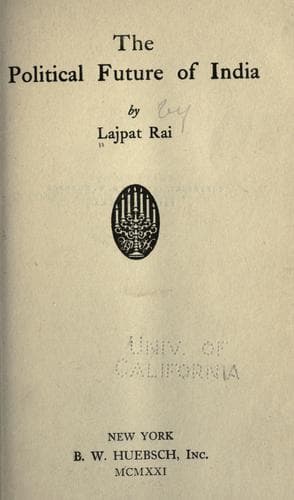
India -- History -- British occupation, 1765-1947; India -- Politics and government -- 1765-1947
our judgment its use as an ideal to be attained expresses more forcibly
the right of the people to choose their government than the use of the
general term "self government" would.
FOOTNOTES:
[1] Paragraph 349 of the _Report_.
IV
THE STAGES
There is no protection for life, property, or money in a State
where the criminal is more powerful than the law. The law of
nations is no exception, and, until it has been vindicated, the
peace of the world will always be at the mercy of any nation whose
professors have assiduously taught it to believe that no crime is
wrong so long as it leads to the aggrandisement and enrichment of
the country to which they owe allegiance.
DAVID LLOYD GEORGE
"No Halfway House." Speech delivered at Gray's
Inn, December 14, 1917.
In the chapter on ideals we have shown that there is almost complete
agreement between the bulk of Indian educated men and the British
authorities as to the immediate goal of Government in India. There is no
such agreement, however, as regards the stages by which that goal is to
be reached, nor on the steps which should be immediately taken to carry
us to the first stage. The four formulas by which Mr. Montagu and Lord
Chelmsford profess to be guided in their recommendations are not
accepted in their entirety by the spokesmen of the Indian people. These
formulas are:
(1) There should be as far as possible complete popular control in
local bodies and the largest possible independence for them of
outside control. (Paragraph 188.)
(2) The provinces are the domain in which the earlier steps
towards the progressive realization of responsible government
should be taken. Some measure of responsibility should be given at
once, and our aim is to give complete responsibility as soon as
conditions permit. This involves at once giving the provinces the
largest measure of independence, legislative, administrative, and
financial, of the Government of India which is compatible with the
due discharge by the latter of its own responsibilities.
(Paragraph 189.)
(3) The Government of India must remain wholly responsible to
Parliament, and saving such responsibility, its authority in
essential matters must remain indisputable pending experience of
the effect of the changes now to be introduced in the provinces.
In the meantime the Indian Legislative Council should be enlarged
and made more representative and its opportunities of influencing
government increased. (Paragraph 190.)
(4) In proportion as the foregoing changes take effect, the
control of Parliament and the Secretary of State over the
Government of India and provincial Governments must be relaxed.
(Paragraph 191.)
Public-domain text, read in full here on John Shaqi.
Reviews
Reviews
No reviews yet
Be the first to share your thoughts on this work.
Join the Discussion
Join the discussion
Sign in to leave a comment or review.
Sign InorCreate an account