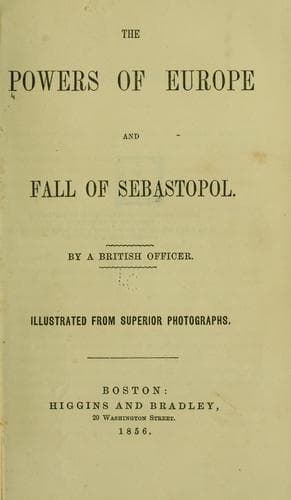
The Powers of Europe and Fall of Sebastopol — John Shaqi
The Powers of Europe and Fall of SebastopolA British officer
History
The Powers of Europe and Fall of Sebastopol
A British officer
Crimean War, 1853-1856; Europe -- History -- 1789-1900
“Upon what trivial events often depend the most important affairs.
The mistake of a captain, who bore away instead of forcing his
passage to the place of his destination, has prevented the face
of the world from being totally changed,” said Napoleon. “Acre,”
continued he, “would otherwise have fallen: I would have flown to
Damascus and Aleppo; and in the twinkling of an eye, would have
been at the Euphrates. I would have reached Constantinople and the
Indies, and would have changed the face of the world.” It was thus in
the assembly of the Notables, called by the intelligent, brilliant,
and careless Calonne, then minister of state, that a member,
complaining of the prodigality of the court, demanded a statement of
the expenses. Another member, punning on the word, exclaimed, “It
is not statements, but States General that we want.” This single
random expression struck every one with astonishment, and seized
by the people was immediately acted upon; the States General were
called, and the public mind was filled with the wildest fermentation:
France and Europe were to be immediately regenerated; visionary
schemes without number were formed; and that general unhinging of
opinions took place, which is the surest prelude of revolution. That
revolution now came, and in its tumults and convulsions the Ancient
French Monarchy rapidly approached its extinction. Amid frightful
disorders, famine appeared; the elements seemed to partake of the
savagery of the times; and the severity of the tempests of summer
which destroyed the harvests, was succeeded by a winter, 1788-9, of
unparalleled rigor. Soon began that vast emigration of the nobility,
which was afterwards succeeded by the attempted flight of the king;
while all authority but that of the Sans Culottes seemed abolished.
Foreign affairs became daily more menacing; the young Emperor,
Francis II. of Austria, was gathering his armies, and soon demanded
the reëstablishment of the monarchy on its ancient footing. All
classes in France now anxiously desired war; the aristocracy hoped
to regain their lost privileges with the assistance of Germany;
the democracy hoped, amid the tumult of victorious campaigns, to
establish their principles.
Public-domain text, read in full here on John Shaqi.
Reviews
Reviews
No reviews yet
Be the first to share your thoughts on this work.
Join the Discussion
Join the discussion
Sign in to leave a comment or review.
Sign InorCreate an account