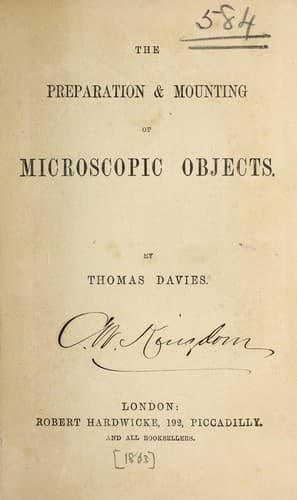
The preparation & mounting of microscopic objectsDavies, Thomas
Science
The preparation & mounting of microscopic objects
Davies, Thomas
Microscopy -- Technique
Dissolve the india-rubber in the naphtha, then add the asphaltum--if
necessary heat must be employed.
This is often used by photographers as a black varnish for glass, and
never cracks, whilst it is very adhesive. Dr. Carpenter, however,
states that his experience has not been favourable to it; but I have
used it in great quantities and have never found it to leave the glass
in a single instance when used in the above proportions. The objections
to it are, however, I think easily explained, when it is known that
there are many kinds of pitch, &c., from coal, sold by the name of
asphaltum, some of which are worthless in making a microscopic cement.
When used for this purpose, the asphaltum must be genuine and of the
best quality that can be bought. The above mixture serves a double
purpose--to unite the cell to the slide, and also as a “finishing”
varnish. But it is perhaps more convenient to have two bottles of this
cement, one of which is thicker than common varnish, to use for uniting
the cell, &c.; the other liquid enough to flow readily, which may be
employed as a surface varnish in finishing the slides.
The brushes or camel-hair pencils should always be cleaned after use;
but with the asphalt varnish above mentioned it is sufficient to wipe
off as carefully as possible the superfluous quantity which adheres to
the pencil, as, when again made use of, the varnish will readily soften
it; but, of course, it will be necessary to keep separate brushes for
certain purposes.
Here it may be observed that every object should be labelled with name
and any other descriptive item as soon as mounted. There are many
little differences in the methods of doing this. Some write with a
diamond upon the slide itself; but this has the disadvantage of being
not so easily seen. For this reason a small piece of paper is usually
affixed to one end of the slide, on which is written what is required.
These labels may be bought of different colours and designs; but the
most simple are quite as good, and very readily procured. Take a sheet
of thin writing paper and brush over one side a strong solution of gum,
with the addition of a few drops of glycerine as above recommended;
allow this to dry, and then with a common gun-punch stamp out the
circles, which may be affixed to the slides by simply damping the
gummed surface, taking care to write the required name, &c., upon it
before damping it, or else allowing it to become perfectly dry first.
There is one difficulty which a beginner often experiences in
sorting and mounting certain specimens under the microscope, viz.,
the _inversion_ of the objects; and it is often stated to be almost
impossible to work without an erector. But this difficulty soon
vanishes, the young student becoming used to working what at first
seems in contradiction to his sight.
Public-domain text, read in full here on John Shaqi.
Reviews
Reviews
No reviews yet
Be the first to share your thoughts on this work.
Join the Discussion
Join the discussion
Sign in to leave a comment or review.
Sign InorCreate an account