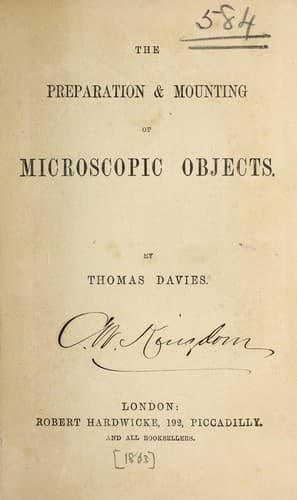
The preparation & mounting of microscopic objectsDavies, Thomas
Science
The preparation & mounting of microscopic objects
Davies, Thomas
Microscopy -- Technique
Let it be understood, that in giving the description of those articles
which are usually esteemed _necessary_ in the various parts of
microscopic manipulation, I do not mean to say that without many of
these no work of any value can be done. There are, as all will allow,
certain forms of apparatus which aid the operator considerably; but
the cost may be too great for him. A little thought, however, will
frequently overcome this difficulty, by enabling him to make, or
get made, for himself, at a comparatively light expense, something
which will accomplish all he desires. As an example of this, a friend
of mine made what he terms his “universal stand,” to carry various
condensers, &c., &c., in the following way:--Take a steel or brass
wire, three-sixteenths or one-quarter inch thick and six or eight
inches long; “tap” into a _solid_, or make rough and fasten with melted
lead into a _hollow_, ball. (The foot of a cabinet or work-box answers
the purpose very well.) In the centre of a round piece of tough board,
three inches in diameter, make a hemispherical cavity to fit half of
the ball, and bore a hole through from the middle of this cavity, to
allow the wire to pass. Take another piece of board, about four inches
in diameter, either round or square, and one-and-a-half or two inches
thick, make a similar cavity in its centre to receive the other half
of the ball, but only so deep as to allow the ball to fit tightly when
the two pieces of board are screwed together, which last operation
must be done with three or four screws. Let the hole for the wire in
the upper part be made conical (base upwards), and so large as only to
prevent the ball from escaping from its socket, in order that the shaft
may move about as freely as possible. Turn a cavity, or make holes,
in the bottom of the under piece, and fill with lead to give weight
and steadiness. This, painted green bronze and varnished, looks neat;
and by having pieces of gutta-percha tubing to fit the shaft, a great
variety of apparatus may be attached to it.
Again, a “condenser” is often required for the illumination of opaque
objects. My ingenious friend uses an “engraver’s bottle” (price 6d.),
fills it with water, and suspends it betwixt the light and the object.
Where the light is very yellow, he tints the water with indigo, and so
removes the objectionable colour.
I merely mention these as examples of what may be done by a little
thoughtful contrivance, and to remove the idea that nothing is of
much value save that which is the work of professional workmen, and
consequently expensive.
CHAPTER II.
TO PREPARE AND MOUNT OBJECTS “DRY.”
The term “dry” is used when the object to be mounted is not immersed
in any liquid or medium, but preserved in its natural state, unless it
requires cleaning and drying.
Public-domain text, read in full here on John Shaqi.
Reviews
Reviews
No reviews yet
Be the first to share your thoughts on this work.
Join the Discussion
Join the discussion
Sign in to leave a comment or review.
Sign InorCreate an account