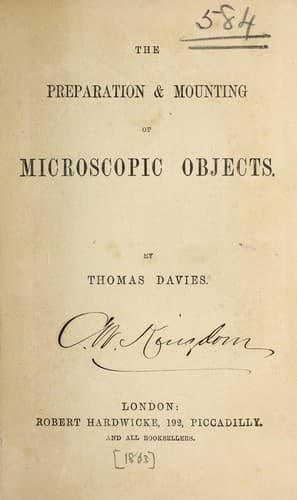
The preparation & mounting of microscopic objectsDavies, Thomas
Science
The preparation & mounting of microscopic objects
Davies, Thomas
Microscopy -- Technique
I have before stated that thorough cleanliness is necessary in the
mounting of all microscopic objects. I may here add that almost every
kind of substance used by the microscopist suffers from careless
handling. Many leaves with fine hairs are robbed of half their beauty,
or the hairs, perhaps, forced into totally different shapes and groups;
many insects lose their scales, which constitute their chief value to
the microscopist; even the glass itself distinctly shows the marks of
the fingers if left uncleaned. Every object must also be _thoroughly
dry_, otherwise dampness will arise and become condensed in small
drops upon the inner surface of the thin glass cover. This defect is
frequently met with in slides which have been mounted quickly; the
objects not being thoroughly dry when enclosed in the cell. Many of the
cheap slides are thus rendered worthless. Even with every care it is
not possible to get rid of this annoyance occasionally.
For the purpose of mounting opaque objects “dry,” _discs_ were at one
time very commonly made use of. These are circular pieces of cork,
leather, or other soft substance, from one-quarter to half inch in
diameter, blackened with varnish or covered with black paper, on which
the object is fixed by gum or some other adhesive substance. They are
usually pierced longitudinally by a strong pin, which serves for the
forceps to lay hold of when being placed under the microscope for
examination. Sometimes objects are affixed to both sides of the disc,
which is readily turned when under the object-glass. The advantage of
this method of mounting is the ease with which the disc may be moved,
and so present every part of the object to the eye save that by which
it is fastened to the disc. On this account it is often made use of
when some particular subject is undergoing investigation, as a number
of specimens may be placed upon the discs with very little labour,
displaying all the parts. But where exposure to the atmosphere or small
particles of dust will injure an object, no advantage which the discs
may possess should be considered, and an ordinary covered cell should
be employed. Small pill-boxes have been used, to the bottom of which a
piece of cork has been glued to afford a ground for the pin or other
mode of attachment; but this is liable to _some_ of the same faults as
the disc, and it would be unwise to use these for permanent objects.
Messrs. Smith and Beck have lately invented, and are now making, a
beautiful small apparatus, by means of which the disc supporting the
object can be worked with little or no trouble into any position that
may prove most convenient, whilst a perforated cylinder serves for the
reception of the discs when out of use, and fits into a case to protect
them from dust. A pair of forceps is made for the express purpose of
removing them from the case and placing them in the holder.
Public-domain text, read in full here on John Shaqi.
Reviews
Reviews
No reviews yet
Be the first to share your thoughts on this work.
Join the Discussion
Join the discussion
Sign in to leave a comment or review.
Sign InorCreate an account