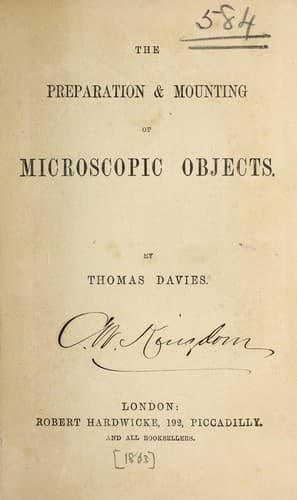
The preparation & mounting of microscopic objects — John Shaqi
The preparation & mounting of microscopic objectsDavies, Thomas
Science
The preparation & mounting of microscopic objects
Davies, Thomas
Microscopy -- Technique
All dry objects, however, which are to be preserved should be mounted
on glass slides in one of the cells (described in Chapter I.) best
suited to them. Where the object is to be free from pressure, care
must be taken that the cell is deep enough to ensure this. When the
depth required is but small, it is often sufficient to omit the card,
leather, or other circles, and with the “turn-table” before described,
by means of a thick varnish and camel-hair pencil, to form a ring
of the desired depth; but should the varnish not be of sufficient
substance to give such “walls” at once, the first application may be
allowed to dry, and a second made upon it. A number of these may be
prepared at the same time, and laid by for use. When liquids are used
(see Chapter IV.), Dr. Carpenter recommends gold-size as a good varnish
for the purpose, and this may be used in “dry” mountings also. I have
used the asphaltum and india-rubber (mentioned in Chapter I.), and
found it to be everything I could wish. The cells, however, must be
_thoroughly dry_, and when they will bear the heat they should be baked
for an hour at least in a tolerably cool oven, by which treatment the
latter becomes a first-rate medium. All dry objects which will not bear
pressure must be firmly fastened to the slide, otherwise the necessary
movements very often injure them, by destroying the fine hairs, &c.
For this purpose thin varnishes are often used, and will serve well
enough for large objects, but many smaller ones are lost by adopting
this plan, as for a time, which may be deemed long enough to harden
the varnish, they exhibit no defect, but in a while a “wall” of the
plastic gum gathers around them, which refracts the light, and thus
leads the student to false conclusions. In all _finer_ work, where it
is necessary to use any method of fixing them to the slide, a solution
of common gum, with the addition of a few drops of glycerine (Chapter
I.), will be found to serve the purpose perfectly. It must, however,
be carefully filtered through blotting paper, otherwise the minute
particles in the solution interfere with the object, giving the slide a
dusty appearance when under the microscope.
Public-domain text, read in full here on John Shaqi.
Reviews
Reviews
No reviews yet
Be the first to share your thoughts on this work.
Join the Discussion
Join the discussion
Sign in to leave a comment or review.
Sign InorCreate an account