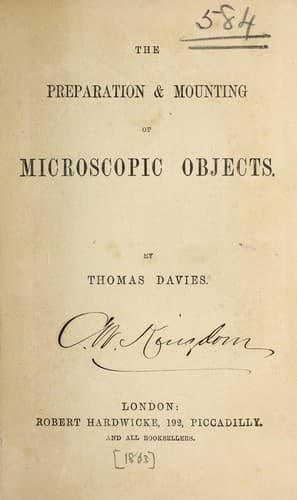
The preparation & mounting of microscopic objects — John Shaqi
The preparation & mounting of microscopic objectsDavies, Thomas
Science
The preparation & mounting of microscopic objects
Davies, Thomas
Microscopy -- Technique
The CORALLINES, many of which are found on almost every coast, afford
some very valuable objects for the microscope. They must be well washed
when first procured, to get rid of all the salts in the sea-water,
dried and mounted in cells deep enough to protect them from all danger
of pressure, as some of them are exceedingly fragile. The white ivory
appearance which some of them present is given to them by an even
covering of carbonate of lime; and should it be desired to examine the
structure of these more closely, it may be accomplished by keeping them
for some time in vinegar or dilute muriatic acid, which will remove the
lime and allow of the substance being sliced in the same way as other
Algæ. (“Micrographic Dictionary,” p. 183.)
THE SCALES OF INSECTS.--The fine dust upon the wings of moths and
butterflies, which is so readily removed when handled carelessly,
is what is generally called _scales_. To these the wing owes the
magnificent colours which so often are seen upon it; every particle
being what may be termed a distinct flat feather. How these are placed
(somewhat like tiles upon a roof) may be easily seen in the wing of
any butterfly, a few being removed to aid the investigation. The form
of them is usually that of the “battledore” with which the common game
is played, but the handle or base of the scale is often short, and the
broad part varies in proportionate length and breadth in different
specimens. The markings upon these also vary, some being mostly
composed of lines running from the base to the apex, others reminding
us of network--bead-like spots only are seen in some--indeed, almost
endless changes are found amongst them. These scales are not confined
to butterflies and moths, nor indeed to the _wings_ of insects. The
different gnats supply some most beautiful specimens, not only from
the wings, but also from the proboscis, &c.; whilst from still more
minute insects, as the podura, scales are taken which were at one time
esteemed as a most delicate test. The gorgeous colours which the
diamond beetles also show when under the microscope are produced by
light reflected from minute scales with which the insects are covered.
Public-domain text, read in full here on John Shaqi.
Reviews
Reviews
No reviews yet
Be the first to share your thoughts on this work.
Join the Discussion
Join the discussion
Sign in to leave a comment or review.
Sign InorCreate an account