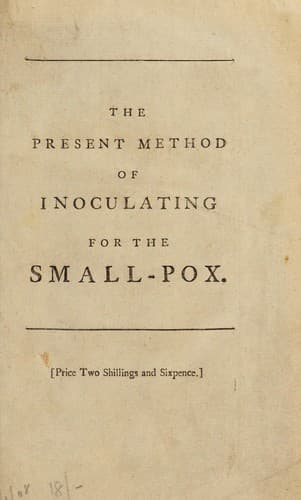
The Present Method of Inoculating for the Small-Pox: To which are added, some experiments, instituted with a view to discover the effects of a similar treatment in the natural small-pox — John Shaqi
The Present Method of Inoculating for the Small-Pox: To which are added, some experiments, instituted with a view to discover the effects of a similar treatment in the natural small-poxDimsdale, Thomas
History
The Present Method of Inoculating for the Small-Pox: To which are added, some experiments, instituted with a view to discover the effects of a similar treatment in the natural small-pox
Dimsdale, Thomas
Smallpox -- Vaccination -- Early works to 1800
The real and essential difference then is to be gathered from the
concomitant symptoms. In the erysipelatous or variolous rash, there
is not so much fever, nor is the restlessness, or a pain of the head
or loins, so considerable; neither is there that general prostration
of strength, which are almost never-failing attendants on a confluent
small-pox, especially when accompanied with such putrid appearances.
Besides, upon a careful examination, there may sometimes be discerned
a few distinct pustules, larger than the rest, mixed with the rash,
which are indeed the real small-pox. In these cases the patients are
ordered to refrain from cold water, or any thing cold, and to keep
within doors, but not to go to bed. If any sickness yet remains, a
little white-wine whey, or other moderate cordial, is advised; and this
method has hitherto been so successful, as to prevent any alarming
complaint. After two or three days, the skin from a florid changes to a
dusky colour, a few distinct pustules remain, and advance properly to
maturation, without any further trouble ensuing from this formidable
appearance[1].
[1] See Cases XIII. XIV.
This rash has often been mistaken for the confluence it so nearly
resembles, and has afforded occasion for some practitioners, either
ignorantly or disingenuously, to pretend, that after a very copious
eruption of the confluent pox, they can by a specific medicine
discharge the major part of the pustules, leaving only as many
distinct ones as may satisfy the patient that he has the disease. Such
pretensions have certainly been made; and the patient, who has been
deceived in this manner, has contributed to spread reports untrue as to
the fact, and probably prejudicial to the health of others, who in like
circumstances have been sent into the open air, by which, and other
cool means, the rash has been repelled, and the bad effects experienced
afterwards.
I must also observe here, that rashes of the kind I have described
frequently happen during the preparation (whether owing to the regimen,
or medicine, or both, I cannot say) and cause the operation to be
postponed: and I have observed, that in such cases they are apt to
return at the time of the eruption of the small-pox.
In general, as has been already said, the symptoms which precede
eruption commence at the end of the seventh, or in the eighth day,
inclusive from the operation; but it often happens that they appear
much sooner, and sometimes much later, than the time above-mentioned.
For instance, I have seen some cases wherein the disease has happened
so suddenly after infection, and with so little complaint or
uneasiness, that the whole affair has been terminated, purges taken,
and the patient returned home perfectly well in a week’s time; before
others, inoculated at the same time, from the same patient, and under
the same circumstances, have begun to complain.
Public-domain text, read in full here on John Shaqi.
Reviews
Reviews
No reviews yet
Be the first to share your thoughts on this work.
Join the Discussion
Join the discussion
Sign in to leave a comment or review.
Sign InorCreate an account