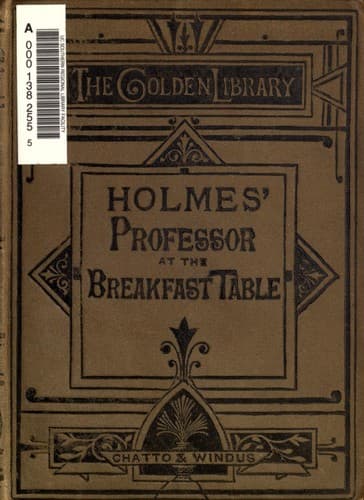
The Professor at the Breakfast-TableHolmes, Oliver Wendell
General
The Professor at the Breakfast-Table
Holmes, Oliver Wendell
American fiction -- 19th century; Conversation -- Fiction; Poetry
The longer I live, the more I am satisfied of two things: first, that
the truest lives are those that are cut rose-diamond-fashion, with many
facets answering to the many-planed aspects of the world about them;
secondly, that society is always trying in some way or other to grind
us down to a single flat surface. It is hard work to resist this
grinding-down action.--Now give me a chance. Better eternal and
universal abstinence than the brutalities of those days that made wives
and mothers and daughters and sisters blush for those whom they should
have honored, as they came reeling home from their debauches! Yet
better even excess than lying and hypocrisy; and if wine is upon all
our tables, let us praise it for its color and fragrance and social
tendency, so far as it deserves, and not hug a bottle in the closet and
pretend not to know the use of a wine-glass at a public dinner! I think
you will find that people who honestly mean to be true really contradict
themselves much more rarely than those who try to be “consistent.” But
a great many things we say can be made to appear contradictory, simply
because they are partial views of a truth, and may often look unlike at
first, as a front view of a face and its profile often do.
Here is a distinguished divine, for whom I have great respect, for I
owe him a charming hour at one of our literary anniversaries, and he
has often spoken noble words; but he holds up a remark of my friend the
“Autocrat,”--which I grieve to say he twice misquotes, by omitting the
very word which gives it its significance,--the word fluid, intended to
typify the mobility of the restricted will,--holds it up, I say, as if
it attacked the reality of the self-determining principle, instead of
illustrating its limitations by an image. Now I will not explain any
farther, still less defend, and least of all attack, but simply quote
a few lines from one of my friend's poems, printed more than ten years
ago, and ask the distinguished gentleman where he has ever asserted more
strongly or absolutely the independent will of the “subcreative centre,”
as my heretical friend has elsewhere called man.
--Thought, conscience, will, to make them all thy own
He rent a pillar from the eternal throne!
--Made in His image, thou must nobly dare
The thorny crown of sovereignty to share.
--Think not too meanly of thy low estate;
Thou hast a choice; to choose is to create!
If he will look a little closely, he will see that the profile and the
full-face views of the will are both true and perfectly consistent!
Public-domain text, read in full here on John Shaqi.
Reviews
Reviews
No reviews yet
Be the first to share your thoughts on this work.
Join the Discussion
Join the discussion
Sign in to leave a comment or review.
Sign InorCreate an account