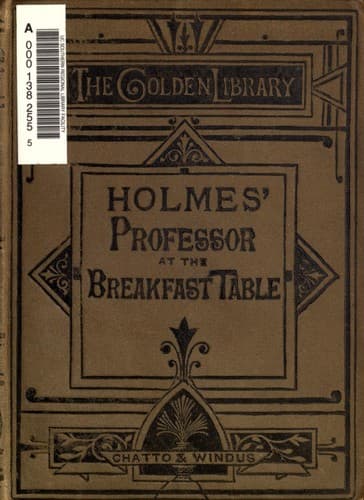
The Professor at the Breakfast-TableHolmes, Oliver Wendell
General
The Professor at the Breakfast-Table
Holmes, Oliver Wendell
American fiction -- 19th century; Conversation -- Fiction; Poetry
Now let us come back, after this long digression, to the conversation
with the intelligent Englishman. We begin skirmishing with a few light
ideas,--testing for thoughts,--as our electro-chemical friend, De Sauty,
if there were such a person, would test for his current; trying a little
litmus-paper for acids, and then a slip of turmeric-paper for alkalies,
as chemists do with unknown compounds; flinging the lead, and looking
at the shells and sands it brings up to find out whether we are like
to keep in shallow water, or shall have to drop the deep-sea line;--in
short, seeing what we have to deal with. If the Englishman gets his
H's pretty well placed, he comes from one of the higher grades of the
British social order, and we shall find him a good companion.
But, after all, here is a great fact between us. We belong to two
different civilizations, and, until we recognize what separates us, we
are talking like Pyramus and Thisbe, without any hole in the wall to
talk through. Therefore, on the whole, if he were a superior fellow,
incapable of mistaking it for personal conceit, I think I would let out
the fact of the real American feeling about Old-World folks. They are
children to us in certain points of view. They are playing with toys we
have done with for whole-generations.
--------FOOTNOTE: The more I have observed and reflected, the more
limited seems to me the field of action of the human will. Every act of
choice involves a special relation between the ego and the conditions
before it. But no man knows what forces are at work in the determination
of his ego. The bias which decides his choice between two or more
motives may come from some unsuspected ancestral source, of which he
knows nothing at all. He is automatic in virtue of that hidden spring
of reflex action, all the time having the feeling that he is
self-determining. The Story of Elsie Yenner, written-soon after this
book was published, illustrates the direction in which my thought was
moving. 'The imaginary subject of the story obeyed her will, but her
will Obeyed the mysterious antenatal poisoning influence.
*****
Public-domain text, read in full here on John Shaqi.
Reviews
Reviews
No reviews yet
Be the first to share your thoughts on this work.
Join the Discussion
Join the discussion
Sign in to leave a comment or review.
Sign InorCreate an account