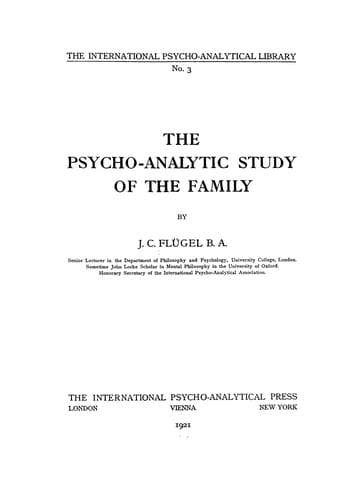
The psycho-analytic study of the familyFlugel, J. C. (John Carl)
Science
The psycho-analytic study of the family
Flugel, J. C. (John Carl)
Families; Marriage; Parent and child; Psychoanalysis
Jung's present position is, in many respects, a reaction against Freud's
views as to the extreme importance of the sexual tendencies in mental
life. With Freud the term Libido had been used to signify the sum total
of these tendencies taken in a sense much wider than that which seems to
have been contemplated by any previous writer; so wide indeed that many
inferred that there could be but a small field left over for the operation
of the other instincts and tendencies. With Jung the reaction against this
attitude takes place not by a restriction of the term Libido to its former
narrower sense, but by a still further extension of its meaning so as to
include all the conative tendencies which manifest themselves in mental
life. By so doing Jung is enabled to take up a relatively non-committal
attitude as regards the sexuality or non-sexuality of many of the factors
which Freud had regarded as definitely sexual in character, while at the
same time he succeeds in minimising the importance of certain unmistakably
sexual manifestations by ignoring their specific character and regarding
them rather exclusively from the point of view of the development and
value of the individual as an independent vital unit.
[Sidenote: The family and the development of the individual]
As regards the application of this general attitude to our own immediate
problem, Jung appears to look upon the family influences as principally of
importance in so far as they afford the necessary conditions and mental
environment for the growth of the general life force of the individual
personality. The child at birth is entirely dependent on his parents for
the satisfaction of his vital needs. His development and education would
appear to consist ultimately in the process of learning to satisfy these
ever increasing needs himself. Hence if the child remains dependent on
his parents for an abnormal length of time or to an abnormal extent, we
may infer that an arrest of development has taken place. Such arrests
are however liable to occur in a great many cases, since the process
of learning to satisfy our own needs by our own efforts is an arduous
business which (in virtue, we may suppose, of some aspect of the law of
inertia) many of us would fain escape if we could. Undue dependence on
the family would therefore appear to indicate a shirking of the "life
task," _i. e._ an unwillingness to make the effort which adult life itself
demands, manifesting itself in an exaggerated tendency to remain at the
stage of relatively slothful ease and maintenance through the efforts of
others which is enjoyed in infancy and early childhood.
[Sidenote: Attachment to the parents regarded as symbolic of deficient
individual development]
Public-domain text, read in full here on John Shaqi.
Reviews
Reviews
No reviews yet
Be the first to share your thoughts on this work.
Join the Discussion
Join the discussion
Sign in to leave a comment or review.
Sign InorCreate an account