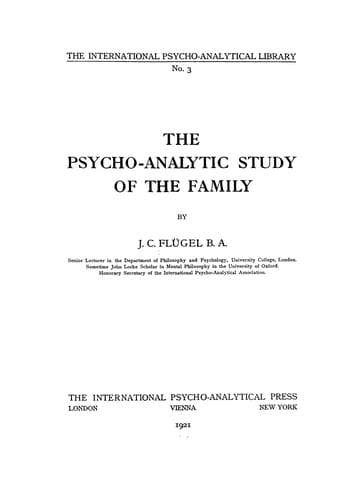
The psycho-analytic study of the familyFlugel, J. C. (John Carl)
Science
The psycho-analytic study of the family
Flugel, J. C. (John Carl)
Families; Marriage; Parent and child; Psychoanalysis
In the neuroses the patient suffers, according to Jung, from an
unconscious tendency to return to this happy state of affairs rather than
to face the hard struggle which adult life may entail. This tendency
expresses itself in a symbolic way, according to the mechanisms which
are characteristic of the neuroses; and what better or more appropriate
symbol is possible than some form of exaggerated attachment to, and
dependence on, the parents--through whom alone that happy time, to which
return is now desired, was possible? Thus it would appear from this point
of view that the incestuous fancies and wishes, to which Freud had drawn
attention, are not to be taken literally as the expression of ultimate
desires, but are only symbols of the wish to escape the hard task which
life imposes and to return once more to the irresponsible condition of
childhood.
[Sidenote: Difficulties presented by this view]
There are probably no experienced psycho-analysts who are prepared to
follow Jung to this last extreme position, in which he appears to deny
all ultimate significance to the sexual aspects of the family complexes.
Jung's view would seem indeed to involve a number of serious difficulties,
amongst which the following are perhaps the most important.
[Sidenote: It does not accord with the general importance of sex]
(1) It does not (as does the view expounded in the earlier chapters)
cast any light upon the origin and development of, nor is it altogether
consistent with, the very important part which the sexual tendencies
play in the conscious and unconscious mind, quite apart from incestuous
desires and fancies. If the principal problem of the neurotic lies in the
difficulty of bracing himself to face the tasks which life imposes, it is
hard to see why sexual feelings, thoughts, phantasies and symbols should
appear in his mind so frequently and so persistently as they are now
generally admitted to do in a very large number of cases.
[Sidenote: It does not explain the strong repression of incest]
(2) Jung's view does not explain why the thought of incestuous relations
should be subject to so much repression as it actually is. If there is in
reality no deep-rooted tendency to such relations, there is no need for
the formation of any powerful mechanism for preventing the fulfilment of
the tendency; whereas if we suppose that the arousal of object love in an
incestuous form is a normal stage of libido development--a stage however
which is superseded in the course of further normal development--the
existence of a strong counter-mechanism, manifesting itself in
consciousness as repulsion and disgust, and in social life in the form
of sexual taboos and "avoidances" connected with the various prohibited
relationships, is precisely what our knowledge of the general conditions
of the development of conative tendencies in the human mind would lead us
to expect.
[Sidenote: Nor the choice of incest as a symbol]
Public-domain text, read in full here on John Shaqi.
Reviews
Reviews
No reviews yet
Be the first to share your thoughts on this work.
Join the Discussion
Join the discussion
Sign in to leave a comment or review.
Sign InorCreate an account