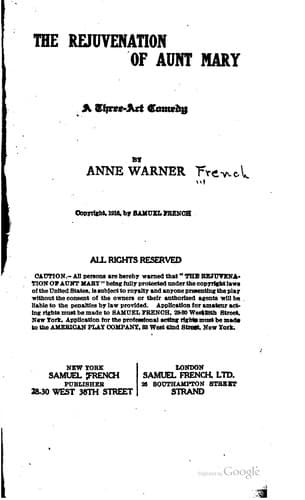
Families -- Fiction; Humorous stories; Man-woman relationships -- Fiction; New York (N.Y.) -- Fiction; Older people -- Fiction
“I think our boy’d better have come home for his Easter,” Aunt Mary
remarked, with a species of angry undertow threading the current of her
speech. “There’s no sayin’ what this will cost before we’re done with
it.”
Arethusa choked; it was all so very terrible to her.
“What is it that the cabman wants, anyhow?” her aunt demanded
presently.
“He doesn’t want anything,” yelled the unhappy sister. “He’s going to
die.”
“Well, who is going to sue me, then?”
“It’s his wife; she wants five thousand dollars damages.”
Aunt Mary’s lips tightened.
“Five thousand dollars!” she said, with a bitter patience. “I can see
that this is goin’ to be an awful business. Five thousand dollars!
Dear, dear! I must say that that wife sets a pretty high price on her
husband—at least, a’cordin’ to my order of thinkin’, she does. From
what I’ve seen of cabmen, I’d undertake to get her another just as good
for a tenth of the money, any day.”
Arethusa was silent, staring thoughtfully at the newspaper cuts of a
great Tammany leader and a noted pugilist, which had been labeled as
the principals in the family tragedy.
Aunt Mary turned over another of the many papers received, and scanned
its sensational columns afresh.
“Arethusa,” she exclaimed suddenly, “do you know, I bet anythin’ I know
what this editor means to insinuate? It just strikes me that he’s
tryin’ to give the impression that our boy’s been drinkin’.”
“Perhaps so,” Arethusa screamed.
“Well, I don’t believe it,” said Aunt Mary firmly, “and I ain’t goin’
to believe it. And I ain’t goin’ to pay no five thousand dollars for no
cabman’s brains, neither. You write to Mr. Stebbins to compromise on
two or maybe three.”
She stopped and bit her lips and shook her head. “I don’t see why Jack
grows up so hard,” she murmured, half in anger and half in sorrow.
“Edward and Henry never had such times. Oh, well,” she sighed, “boys
will be boys, I suppose; an’ if this all results in the boy’s settlin’
down it’ll be money well spent in the end, after all.
Maybe—probably—most likely.”
The days that followed were anxious days, but at last the cabman
rallied and concluded not to die, and Jack went off yachting with a
light heart and a choice collection of good advice from Mr. Stebbins
and Aunt Mary.
Nothing happened to mar his holiday. He ran a borrowed steam launch on
to some rocks with rather heavy consequences to his aunt’s exchequer,
and returned from the West Indies so late that she never had a visit
from him at all that summer; but, barring these slightly unwelcome
incidents, he did remarkably well, and when he returned to college in
the fall he was regarded as having become, at last, a stable
proposition.
Public-domain text, read in full here on John Shaqi.
Reviews
Reviews
No reviews yet
Be the first to share your thoughts on this work.
Join the Discussion
Join the discussion
Sign in to leave a comment or review.
Sign InorCreate an account