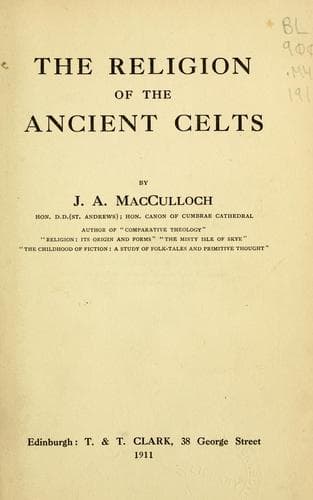
The Religion of the Ancient CeltsMacCulloch, J. A. (John Arnott)
Religion
The Religion of the Ancient Celts
MacCulloch, J. A. (John Arnott)
Celts -- Religion; Mythology, Celtic
Most of the Celtic divinities were local in character, each tribe
possessing its own group, each god having functions similar to those of
other groups. Some, however, had or gained a more universal character,
absorbing divinities with similar functions. Still this local character
must be borne in mind. The numerous divinities of Gaul, with differing
names--but, judging by their assimilation to the same Roman divinity,
similar functions, are best understood as gods of local groups. This is
probably true also of Britain and Ireland. But those gods worshipped far
and wide over the Celtic area may be gods of the undivided Celts, or
gods of some dominant Celtic group extending their influence on all
sides, or, in some cases, popular gods whose cult passed beyond the
tribal bounds. If it seem precarious to see such close similarity in the
local gods of a people extending right across Europe, appeal can be made
to the influence of the Celtic temperament, producing everywhere the
same results, and to the homogeneity of Celtic civilisation, save in
local areas, e.g. the South of Gaul. Moreover, the comparison of the
various testimonies of onlookers points to a general similarity, while
the permanence of the primitive elements in Celtic religion must have
tended to keep it everywhere the same. Though in Gaul we have only
inscriptions and in Ireland only distorted myths, yet those testimonies,
as well as the evidence of folk-survivals in both regions, point to the
similarity of religious phenomena. The Druids, as a more or less
organised priesthood, would assist in preserving the general likeness.
Thus the primitive nature-spirits gave place to greater or lesser gods,
each with his separate department and functions. Though growing
civilisation tended to separate them from the soil, they never quite
lost touch with it. In return for man's worship and sacrifices, they
gave life and increase, victory, strength, and skill. But these
sacrifices, had been and still often were rites in which the
representative of a god was slain. Some divinities were worshipped over
a wide area, most were gods of local groups, and there were spirits of
every place, hill, wood, and stream. Magic rites mingled with the cult,
but both were guided by an organised priesthood. And as the Celts
believed in unseen gods, so they believed in an unseen region whither
they passed after death.
Public-domain text, read in full here on John Shaqi.
Reviews
Reviews
No reviews yet
Be the first to share your thoughts on this work.
Join the Discussion
Join the discussion
Sign in to leave a comment or review.
Sign InorCreate an account