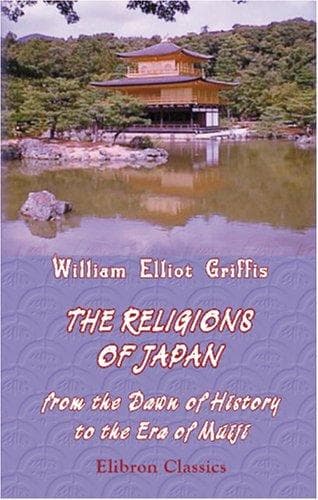
The Religions of Japan, from the Dawn of History to the Era of Méiji — John Shaqi
The Religions of Japan, from the Dawn of History to the Era of MéijiGriffis, William Elliot
Religion
The Religions of Japan, from the Dawn of History to the Era of Méiji
Griffis, William Elliot
Japan -- Religion
Japan is young beside China and Korea.--Japanese history is
comparatively modern.--The oldest documents date from A.D. 712.--The
Japanese archipelago inhabited before the Christian era.--Faith, worship
and ritual are previous to written espression.--The Kojiki, Manyōshu
and Norito.--Tendency of the pupil nations surrounding China to antedate
their civilization.--Origin of the Japanese people and their
religion.--Three distinct lines of tradition from Tsukushi, Idzumo and
Yamato.--War of the invaders against the aborigines--Mikadoism is the
heart of Shintō.--Illustrations from the liturgies.--Phallicism among
the aborigines and common people.--The mind or mental climate of the
primæval man.--Representation of male gods by emblems.--Objects of
worship and _ex-voto_.--Ideas of creation.--The fire-myth,
Prometheus.--Comparison of Greek and Japanese mythology.--Ritual for the
quieting of the fire-god.--The fire-drill.
CHAPTER III
THE KOJIKI AND ITS TEACHINGS, PAGE 59
Origin of the Kojiki. Analysis of its opening lines--Norito.--Indecency
of the myths of the Kojiki.--Modern rationalistic interpretations--Life
in prehistoric Japan.--Character and temperament of the people then and
now.--Character of the kami or gods.--Hades.--Ethics.--The Land of the
Gods.--The barbarism of the Yamato conquerors an improvement upon the
savagery of the aborigines.--Cannibalism and human sacrifices.--The
makers of the God-way captured and absorbed the religion of the
aborigines.--A case of syncretism.--Origin of evil in bad
gods.--Pollution was sin.--Class of offences enumerated in the
norito.--Professor Kumi's contention that Mikadoism usurped a simple
worship of Heaven.--Difference between the ancient Chinese and ancient
Japanese cultus.--Development of Shintō arrested by
Buddhism.--Temples and offerings.--The tori-i.--Pollution and
purification.--Prayer.--Hirata's ordinal and specimen prayers.--To the
common people the sun is a god.--Prayers to myriads of gods.--Summary of
Shintō.--Swallowed up in the Riyōbu system.--Its modern
revival.--Kéichin.--Kada Adzumarō.--Mabuchi, Motoöri.--Hirata.--In
1870, Shintō is again made the state religion.--Purification of
Riyōbu temples.--Politico-religious lectures.--Imperial
rescript.--Reverence to the Emperor's photograph.--Judgment upon
Shintō.--The Christian's ideal of Yamato-damashii.
CHAPTER IV
THE CHINESE ETHICAL SYSTEM IN JAPAN, PAGE 99
Public-domain text, read in full here on John Shaqi.
Reviews
Reviews
No reviews yet
Be the first to share your thoughts on this work.
Join the Discussion
Join the discussion
Sign in to leave a comment or review.
Sign InorCreate an account