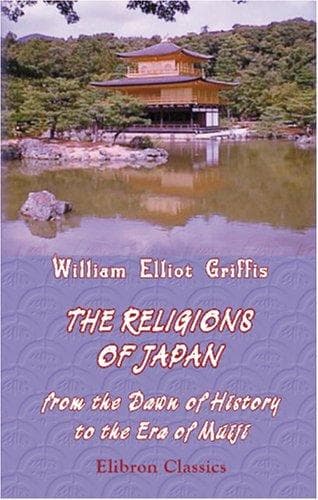
The Religions of Japan, from the Dawn of History to the Era of Méiji — John Shaqi
The Religions of Japan, from the Dawn of History to the Era of MéijiGriffis, William Elliot
Religion
The Religions of Japan, from the Dawn of History to the Era of Méiji
Griffis, William Elliot
Japan -- Religion
In what respects Confucius was unique as a teacher.--Outline of his
life.--The canon.--Primitive Chinese faith a sort of monotheism.--How
the sage modified it.--History of Confucianism until its entrance into
Japan.--Outline of the intellectual and political history of the
Japanese.--Rise of the Samurai class.--Shifting of emphasis from filial
piety to loyalty.--Prevalence of suicide in Japan.--Confucianism has
deeply tinged the ideas of the Japanese.--Great care necessary in
seeking equivalents in English for the terms used in the Chino-Japanese
ethics; e.g., the emperor, "the father of the people."--Impersonality of
Japanese speech.--Christ and Confucius.--"Love" and
"reverence."--Exemplars of loyalty.--The Forty-seven Rōnins.--The
second relation.--The family in Chinese Asia and in Christendom.--The
law of filial piety and the daughter.--The third relation.--Theory of
courtship and marriage.--Chastity.--Jealousy.--Divorce.--Instability of
the marriage bond.--The fourth relation.--The elder and the younger
brother.--The house or family everything, the individual nothing.--The
fifth relation.--The ideas of Christ and those of Confucius.--The Golden
and the Gilded rule.--Lao Tsze and Kung.--Old Japan and the
alien.--Commodore Perry and Professor Hayashi.
CHAPTER V
CONFUCIANISM IN ITS PHILOSOPHICAL FORM, PAGE 131
Harmony of the systems of Confucius and Buddha in Japan during a
thousand years.--Revival of learning in the seventeenth century.--Exodus
of the Chinese scholars on the fall of the Ming dynasty.--Their
dispersion and work in Japan.--Founding of schools of the new Chinese
learning.--For two and a half centuries the Japanese mind has been
moulded by the new Confucianism.--Survey of its rise and
developments.--Four stages in the intellectual history of China.--The
populist movement in the eleventh century.--The literary
controversy.--The philosophy of the Cheng brothers and of Chu Hi, called
in Japan Tei-Shu system.--In Buddhism the Japanese were startling
innovators, in philosophy they were docile pupils.--Paucity of Confucian
or speculative literature in Japan.--A Chinese wall built around the
Japanese intellect.--Yelo orthodoxy.--Features of the Téi-Shu
system.--Not agnostic but pantheistic.--Its influence upon
historiography.--Ki (spirit) Ri (way) and Ten (heaven).--The writings of
Ohashi Junzo.--Confucianism obsolescent in New Japan.--A study of
Confucianism in the interest of comparative religion.--Man's place in
the universe.--The Samurai's ideal, obedience.--His fearlessness in the
face of death.--Critique of the system.--The ruler and the ruled.--What
has Confucianism done for woman?--Improvement and revision of the fourth
and fifth relations.--The new view of the universe and the new mind in
New Japan. The ideal of Yamato-damashii revised and improved.
CHAPTER VI
THE BUDDHISM OF NORTHERN ASIA, PAGE 153
Public-domain text, read in full here on John Shaqi.
Reviews
Reviews
No reviews yet
Be the first to share your thoughts on this work.
Join the Discussion
Join the discussion
Sign in to leave a comment or review.
Sign InorCreate an account