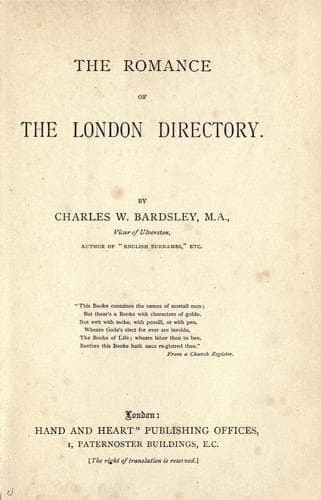
The Romance of the London DirectoryBardsley, Charles Wareing Endell
History
The Romance of the London Directory
Bardsley, Charles Wareing Endell
Names, English -- England -- London; Names, Personal -- England -- London
Thus there are three distinct variations of Christian name, surname, and
place of residence,—nine in all, when only nine were possible! This,
too, in a formal legal document. Take another instance given to me by J.
Paul Rylands, F.S.A. In Edward the Third’s reign lived one Henry le
Machun by name. His son was Adam le Machoun. Passing downwards, his
descendants are found as Macound, Macount, Macont, till in 1584 they are
Macon, a year later Maconde. In 1592 they are Makant, and Makont, in
1609 Macante, in 1610 Makin, in 1620 Macond, in 1624 Meacon, in 1626
Meakin, in 1644 Macant, in 1650 Meakyn. We are in a perfect wilderness
by the time the last entry is reached,—and thus some of our present
Makins, instead of deriving their surname from Makin, the once pet name
of Matthew, may be descended from Mason, which, belonging to a totally
different class, owes its existence to the occupation of its first
bearer. Thus, as we turn over the pages of the London Directory, we are
being ever struck by the many guises under which one single name may
appear. It is palpable to the most uninitiated that Langwith, Langworth,
and Langworthy are all the same, and that all _may have_ had the same
common ancestor. The merest tyro in nomenclatural knowledge must
recognise at a glance that Gibbins, Gibbings, and Gibbons are one and the
same name, and that Smithers, Smithies, and Smithyes may have boasted a
common progenitor. There is no Raleigh in the London Directory. Has,
then, Sir Walter no representative? Yes, for there are three Rawleys,
who have learnt to spell their name as it was _pronounced_ three
centuries ago. But how do we know Sir Walter’s name was pronounced like
Rawley? The following skit was written at the poet’s expense by a
contemporary critic, who attacked his supposed atheistic notions. We may
premise that _Walter_ was always pronounced _Water_ then.
“_Water_ thy plants with grace divine,
And hope to live for aye:
Then to thy Saviour Christ incline,
In Him make stedfast stay.
_Raw_ is the reason that doth _lie_
Within an atheist’s head,
Which saith the soul of man doth die,
When that the body’s dead.
Now may you see the sudden fall
Of him that thought to climb full high;
A man well known unto you all,
Whose state, you see, doth stand _Rawly_.”
The last word is supposed to mean “rarely,” and thus a double pun is
attempted, both proving the name to have been pronounced in a fashion not
common now.
Public-domain text, read in full here on John Shaqi.
Reviews
Reviews
No reviews yet
Be the first to share your thoughts on this work.
Join the Discussion
Join the discussion
Sign in to leave a comment or review.
Sign InorCreate an account