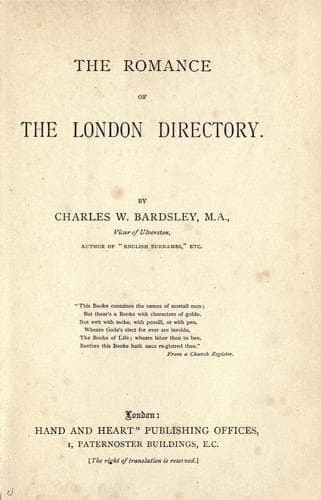
The Romance of the London DirectoryBardsley, Charles Wareing Endell
History
The Romance of the London Directory
Bardsley, Charles Wareing Endell
Names, English -- England -- London; Names, Personal -- England -- London
Of the utility there could be no doubt. In wet weather, as already
hinted, everybody who had a coat collar had to turn it up to prevent each
swinging sign from dripping the rain-water down the back of the neck.
Umbrellas were still rare, costly, and curious luxuries. In a word, the
swinging sign was voted an intolerable nuisance, was found guilty, and
condemned—not to the gallows, of course, for the charge against it was
that it had been hanging there to the public detriment all its days—but
to oblivion. I daresay London had made away with many of its cumbersome
signboards many years before the provincial towns. It is curious to note
that in a hundred different nooks and corners of old London there still
linger some of the tradesmen’s signs, either flattened against the wall,
or carved upon the now crumbling stonework.
There are endless allusions to the signs of old London in the comic or
semi-comic rhymes of the period. Thomas Heywood, early in the
seventeenth century, says:—
“The gintry to the _King’s Head_,
The nobles to the _Crown_,
The knights unto the _Golden Fleece_,
And to the _Plough_ the clowne.
The Churchman to the _Mitre_,
The shepherd to the _Star_,
The gardener hies him to the _Rose_,
To the _Drum_ the man of war.”
There is a capital collection of these names in a ballad of the
Restoration, which is far too long to quote in full, but of which the
following is a specimen:—
“Through the Royal Exchange as I walked,
Where gallants in sattin doe shine,
At midst of the day they parted away,
To seaverall places to dine.
The ladyes will dine at the _Feathers_,
The _Globe_ no captaine will scorne,
The huntsman will goe to the _Greyhound_ below,
And some will hie to the _Horne_.
The farriers will to the _Horse_,
The blacksmith unto the _Locke_,
The butchers unto the _Bull_ will goe,
And the carmen to Bridewell _Clocke_.
The pewterers to the _Quarte Pot_,
The coopers will dine at the _Hoope_,
The coblers to the _Last_ will goe,
And the bargemen to the _Sloope_.
The goldsmith will to the _Three Cups_,
For money they hold it as drosse;
Your Puritan to the _Pewter-canne_,
And your Papists to the _Crosse_.
Thus every man in his humour,
That comes from the northe or the southe;
But he that has no money in his purse
May dine at the signe of the _Mouth_.”
Again, Pasquin, in his “Night-cap,” says:—
“First there is Maister Peter at the _Bell_,
A linen draper, and a wealthy man;
Then Maister Thomas that doth stockings sell,
And George the grocer at the _Frying Pan_.
And Maister Miles the mercer at the _Harrow_,
And Maister Mike the silkman at the _Plow_,
And Maister Nicke the Salter at the _Sparrow_,
And Maister Dicke the vintner at the _Cow_.”
Another jingling rhyme began:—
Public-domain text, read in full here on John Shaqi.
Reviews
Reviews
No reviews yet
Be the first to share your thoughts on this work.
Join the Discussion
Join the discussion
Sign in to leave a comment or review.
Sign InorCreate an account