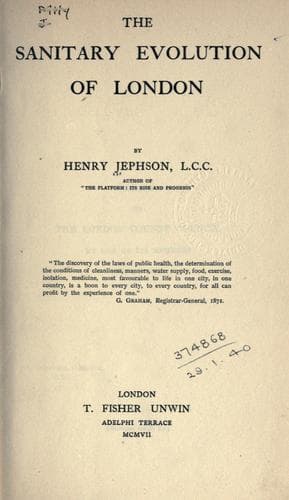
The Sanitary Evolution of LondonJephson, Henry (Henry Lorenzo)
History
The Sanitary Evolution of London
Jephson, Henry (Henry Lorenzo)
Public health -- England -- London
"The Court of Burgesses and the Vestry retained general jurisdiction
over the whole parish for certain purposes; but the numerous local Acts
so effectually subdivided the control and distributed it among boards,
commissioners, trustees, committees, and other independent bodies, that
uniformity, efficiency, and economy in local administration had become
impossible."[8]
There were authorities exclusively for paving; authorities for street
improvements; authorities for lighting; even authorities for a bridge
across the river. In the course of years, several hundred such bodies
had been created, without any relation one to the other, and without
any central controlling authority, good, bad, or indifferent, by as
many Acts of Parliament. They were mostly self-elected, or elected for
life, or both; and were wholly irresponsible to the ratepayers, or
indeed to any one else; nor were their proceedings in any way open to
the public. Many of them had large staffs of well paid officials; and
there were perpetual conflicts of jurisdiction between them, and an
absolute want of anything approaching to municipal administration.
It has been roughly stated--roughly because there are no reliable
figures--that there were about three hundred such bodies in
London--"jostling, jarring, unscientific, cumbrous, and costly"--the
very nature of many of them being "as little known to the rest of the
community as that of the powers of darkness."
Add to these numerous, clashing, and incompetent authorities, various
great public companies or corporations--the water companies, and gas
companies, and dock companies, each with its own special rights--which
were far more favourably and generously regarded by Parliament than
were the rights of the public, and one has fairly enumerated the local
governing bodies then existing in London.
In fact, in no parish of the great metropolis of London was there a
local authority possessed of powers to deal in its own area with the
multitudinous affairs affecting the health and well-being of the people.
Nor was there in the metropolis any central authority--no single body,
representative or even otherwise--to attend to the great branches of
municipal administration which affected and concerned the metropolis
as a whole, and which could only be dealt with efficiently by the
metropolis being treated as a whole.
The consequences to the inhabitants of London of the absence of any
efficient form of local government were dire in character, terrible
in extent, and unceasing in operation. The higher grades of society
suffered in some degree, as disease, begotten in filth and nurtured in
poverty, often invaded with disastrous consequences the homes of the
well-to-do; but it was by the great mass of the industrial classes and
the poorer people that the terrible burden of insanitation had to be
borne, and upon them that it fell with the deadliest effect.
Public-domain text, read in full here on John Shaqi.
Reviews
Reviews
No reviews yet
Be the first to share your thoughts on this work.
Join the Discussion
Join the discussion
Sign in to leave a comment or review.
Sign InorCreate an account