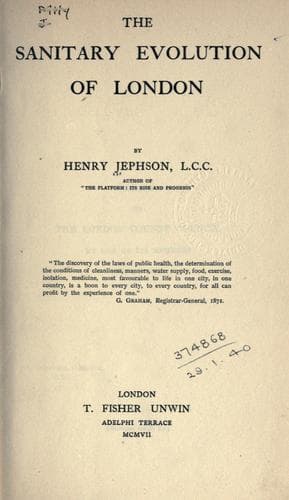
The Sanitary Evolution of LondonJephson, Henry (Henry Lorenzo)
History
The Sanitary Evolution of London
Jephson, Henry (Henry Lorenzo)
Public health -- England -- London
There was no authority so important as to have any extended area for
municipal purposes under its control and management except certain
bodies, five in number, entitled "Commissioners of Sewers," charged
with duties in connection with the sewerage of their districts.
In some parishes some of the affairs of the parish were managed by the
parishioners in open vestry assembled, at which assembly Churchwardens,
Overseers of the Poor, and Surveyors of Highways were appointed to
carry out certain limited classes of work. In others, the parishioners
elected a select vestry to do the work of the parish.
But for many of the vitally important municipal affairs there were no
authorities at all.
As the non-City and out-districts became more thickly peopled, and
streets and houses increased in number, the inconvenience of there
being practically no local government at all made itself felt.
In some cases, the owners of the estates which were being so rapidly
absorbed into London and being built upon, applied to Parliament for
powers to regulate those estates.
In other cases, persons with interests in a special locality associated
themselves together and obtained a private Act of Parliament giving
them authority, under the name of Commissioners or Trustees, to tax
and in a very limited way to govern a particular district or group
of streets forming part of a parish. Thus it happened that a large
number of petty bodies of all sorts and kinds came into existence.
Any district, however small, was suffered to obtain a local Act of
Parliament for the purpose of managing some of its affairs, and
this, too, without any reference to the interests of the immediate
neighbours, or of the metropolis as a whole. Most of the limited and
somewhat primitive powers possessed by them were derived from an
Act passed in 1817,[6] and related to the paving of streets and the
prevention of nuisances therein. Some of these bodies were authorised
to appoint surveyors or inspectors; also "scavengers, rakers, or
cleaners" to carry away filth from streets and houses, but the exercise
of such powers was, of course, purely optional. Indeed, there were
scarcely any two parishes in London governed alike.
What the exact number of these various petty authorities was is
unknown. Of paving boards alone, it is said that about the middle
of the last century there were no less than eighty-four in the
metropolis--nineteen of them being in one parish. The lighting of
the parish of Lambeth was under the charge of nine local trusts. The
affairs of St. Mary, Newington, were under the control of thirteen
Boards or trusts, in addition to two turnpike trusts.[7]
In Westminster:--
Public-domain text, read in full here on John Shaqi.
Reviews
Reviews
No reviews yet
Be the first to share your thoughts on this work.
Join the Discussion
Join the discussion
Sign in to leave a comment or review.
Sign InorCreate an account