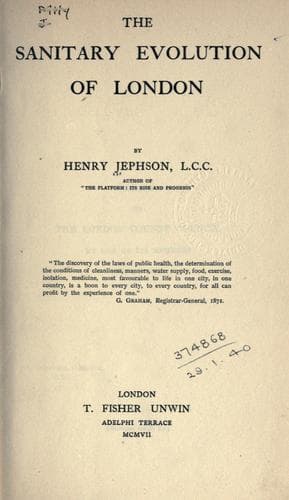
The Sanitary Evolution of LondonJephson, Henry (Henry Lorenzo)
History
The Sanitary Evolution of London
Jephson, Henry (Henry Lorenzo)
Public health -- England -- London
The non-existence of a central authority, or of any capable local
authorities whose function it would have been to protect them from the
causes of disease, had resulted in an insanitary condition which year
after year entailed the waste of thousands upon thousands of lives.
And the people, in the cruel circumstances of their position, were
absolutely powerless to help themselves, and had no possible means of
escape from the ever-present, all-surrounding danger.
The first absolute necessity of any sanitation whatever is the getting
rid by deportation or destruction of all the filth daily made or left
by man or beast, for such filth or refuse breeds all manner of disease,
from the mildest up to the very worst types and sorts, and promptly
becomes not only noxious to health, but fatal to life. The more rapidly
and thoroughly, therefore, this riddance is effected, the better is it
in every way for the general health of the public.
So far as the metropolis was concerned, this necessity had for
generation after generation been very lightly regarded; and when at
last it so forced itself upon public notice that it could no longer be
ignored, the measures taken were wholly inadequate and ineffective.
What system there was in London as to the disposal of sewage throughout
the earlier half of last century was based upon a Statute dating so far
back as Henry VIII.'s reign, amended by another in William and Mary's
reign. Under these Statutes certain bodies had been constituted by
the Crown as Commissioners of Sewers for certain portions of London,
and charged with the duty of providing sewers and drains in their
respective districts, and maintaining the same in proper working order.
But what might have been good enough for London in the sixteenth or
seventeenth centuries was certainly not adequate in the nineteenth,
when London had extended her borders in every direction, and her
population had reached almost two and a half millions. Successive
Parliaments had not troubled themselves about such a matter; and this
neglect, which now appears almost incredible, was typical of the
habitual attitude of the governing classes to the sanitary requirements
of the masses of the population of the metropolis.
In the eighteen hundred and forties, five such bodies of Commissioners
were in existence in London, each with a separate portion of the
metropolis under its charge and exercising an independent sway in its
own district; and when we collect the best testimony of that time as
to their work and that of their predecessors, we have the clearest
demonstration of their glaring incapacity, and of the utter inadequacy
and inefficiency of the sewerage in their respective districts.
Many miles of sewers had, it is true, in process of time been
constructed, and did exist, but much of the work had been so misdone
that the cure was little better than the disease.
Public-domain text, read in full here on John Shaqi.
Reviews
Reviews
No reviews yet
Be the first to share your thoughts on this work.
Join the Discussion
Join the discussion
Sign in to leave a comment or review.
Sign InorCreate an account