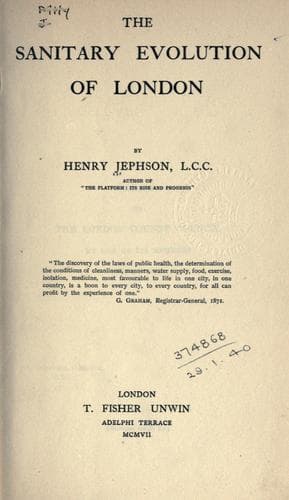
The Sanitary Evolution of LondonJephson, Henry (Henry Lorenzo)
History
The Sanitary Evolution of London
Jephson, Henry (Henry Lorenzo)
Public health -- England -- London
A river is always a great temptation to persons to get rid of things
they want to get rid of, particularly when the things are nasty and
otherwise not easily disposed of. Londoners only followed the general
practice when they constructed their sewers so that they discharged
their contents direct into the Thames. The majority of these sewers
emptied themselves only at the time of low water; for as the tide rose
the outlets of the sewers were closed, and the sewage was dammed back
and became stagnant. When the tide had receded sufficiently to afford
a vent for the pent-up sewage, it flowed out and deposited itself
along the banks of the river, evolving gases of a foul and offensive
character. And then the sewage was not only carried up the river by
the rising tide, but it was brought back again into the heart of the
metropolis, there to mix with each day's fresh supply of sewage; the
result being that "the portion of the river within the metropolitan
district became scarcely less impure and offensive than the foulest of
the sewers themselves."
This was bad enough, but there were miles of sewers which, through
defects of construction or disrepair, did not even carry off the sewage
from the houses and streets to the river, but had become "similar to
elongated cesspools," and, as such, actual sources and creators of
disease.
Incredible almost were the stupidities perpetrated by these
Commissioners in regard to the construction of the sewers. At even
so late a date as 1845 no survey had been made of the metropolis for
the purposes of drainage; there was a different level in each of the
districts, and no attempt was made to conform the works of the several
districts to one general plan. Large sewers were made to discharge into
smaller sewers. Some were higher than the cesspools which they were
supposed to drain, whilst others had been so constructed that to be of
any use the sewage would have had to flow uphill!
It might reasonably have been expected that in the nineteenth century,
at least, the twenty parishes which formed the district of the
Westminster Commissioners of Sewers would have been equal to producing
an enlightened and capable body as Commissioners, but the Westminster
Court of Sewers was certainly not such. Even their own chief surveyor,
in 1847, stigmatised it as a body "totally incompetent to manage the
great and important works committed to their care and control."
Upon it were builders, surveyors, architects, and district surveyors--a
class of persons whose opinions "might certainly be biassed with
relation to particular lines of drains and sewers."
Of another of the courts--namely, the Finsbury Court of Sewers--one of
the Commission had been outlawed; another was a bankrupt.
Public-domain text, read in full here on John Shaqi.
Reviews
Reviews
No reviews yet
Be the first to share your thoughts on this work.
Join the Discussion
Join the discussion
Sign in to leave a comment or review.
Sign InorCreate an account