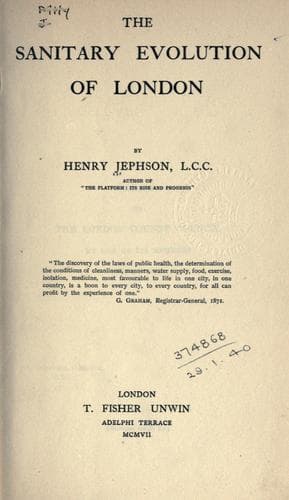
The Sanitary Evolution of LondonJephson, Henry (Henry Lorenzo)
History
The Sanitary Evolution of London
Jephson, Henry (Henry Lorenzo)
Public health -- England -- London
It was stated at the time that "jobbery and favouritism and
incompetence were rampant," and that the system was "radically wrong
and rotten to the core." Certain it is that these bodies failed
completely to cope with the requirements of the time. London was
spreading out in all directions, and the increase of houses and
population was very rapid. Practically no effort, however--certainly
no adequate effort--was made by the various bodies of Commissioners to
provide these new and growing districts with the means of getting rid
of their sewage. And then, inasmuch as the sewage had somehow or other
to be got rid of, and some substitute for sewers devised, the surface
drains, and millstreams, and ditches were appropriated to use and
converted into open sewers or "stagnant ponds of pestilential sewage."
London was "seamed with open ditches."
According to contemporary reports there were in Lambeth numerous open
ditches of the most horrible description. Bermondsey was intersected
by ditches of a similar character, and abounded with fever nests.
Rotherhithe was the same. Hackney Brook, formerly "a pure stream," had
become "a foul open sewer."[9] In St. Saviour's Union the sewers were
in a dreadful condition ... "the receptacle of all kinds of refuse,
such as putrid fish, dead dogs, cats, &c. Greenwich was not drained or
sewered."
What certainly was conclusively demonstrated was that the existence
of several bodies of Commissioners, each with a district to itself,
presented an insuperable obstacle to any general system of sewerage for
greater London; and that one capable central authority was the first
essential of an adequate and efficient system for London as a whole.
Thus, then, in this first essential of all sanitation--one might say
of civilisation--no adequate provision was made by Parliament for the
safety of the metropolis; whilst as to other essentials of sanitation,
there were no laws for the prevention of the perpetration of every
sanitary iniquity; and such authorities as there were failed absolutely
to use even the few powers they possessed.
Public-domain text, read in full here on John Shaqi.
Reviews
Reviews
No reviews yet
Be the first to share your thoughts on this work.
Join the Discussion
Join the discussion
Sign in to leave a comment or review.
Sign InorCreate an account