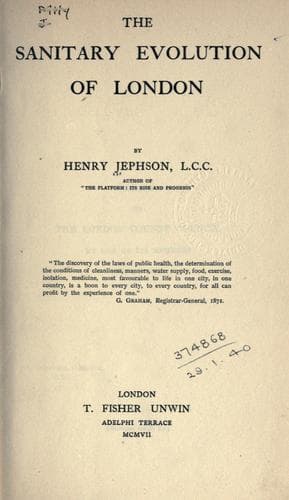
The Sanitary Evolution of LondonJephson, Henry (Henry Lorenzo)
History
The Sanitary Evolution of London
Jephson, Henry (Henry Lorenzo)
Public health -- England -- London
The defective and inefficient sewerage of the metropolis precluded the
possibility of any proper system of house drainage, for there being few
sewers there were few drains, and consequently instead of drains from
the houses to the sewers there were cesspools under almost every house.
At the census of 1841 there were over 270,000 houses in the metropolis.
It was known, then, that most houses had a cesspool under them, and
that a large number had two, three, or four under them. Some of them
were so huge that the only name considered adequate to describe them
was "cess-lake." In many districts even the houses in which the better
classes lived had neither drain nor sewer--nothing but cesspools;
and many of the very best portions of the West End were "literally
honeycombed" with them. And so jealous was the law as regarded the
rights of private property that so late as 1845 owners were not to be
interfered with as regarded even their cesspools, no matter how great
the nuisance might be to their neighbours, no matter how dangerous
to the community at large. Indeed, the Commissioners of Sewers had
no power to compel landlords or house-owners to make drains into the
sewers, and of their own motion the landlords would take no action.
In the lower part of Westminster the Commissioners of Sewers had
actually carried sewers along some of the streets, but they found "very
little desire on the part of the landlords" to use them. "So long as
the owners get their rent they do not care about drainage.... The
landlords will not move; their property pays them very well; they will
not put themselves to any expense; they are satisfied with it as it
stands."
Strange level of satisfaction! when one reads the following evidence
given two years later before the Metropolitan Sewers Commission:--
"There are hundreds, I may say thousands, of houses in this metropolis
which have _no drainage whatever_, and the greater part of them have
stinking, overflowing cesspools. And there are also hundreds of
streets, courts, and alleys, that have no sewers; and how the drainage
and filth is cleared away, and how the poor miserable inhabitants live
in such places it is hard to tell.
"In pursuance of my duties, from time to time, I have visited very
many places where filth was lying scattered about the rooms, vaults,
cellars, areas, and yards, so thick, and so deep, that it was hardly
possible to move for it. I have also seen in such places human
beings living and sleeping in sunk rooms with filth from overflowing
cesspools exuding through and running down the walls and over the
floors.... The effects of the stench, effluvia, and poisonous gases
constantly evolving from these foul accumulations were apparent in the
haggard, wan, and swarthy countenances, and enfeebled limbs, of the
poor creatures whom I found residing over and amongst these dens of
pollution and wretchedness."[10]
And this witness was unable to refrain from passing a verdict upon what
he had seen:--
Public-domain text, read in full here on John Shaqi.
Reviews
Reviews
No reviews yet
Be the first to share your thoughts on this work.
Join the Discussion
Join the discussion
Sign in to leave a comment or review.
Sign InorCreate an account