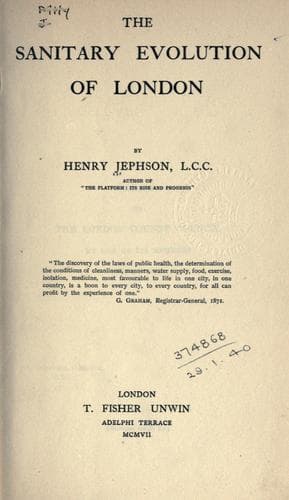
The Sanitary Evolution of LondonJephson, Henry (Henry Lorenzo)
History
The Sanitary Evolution of London
Jephson, Henry (Henry Lorenzo)
Public health -- England -- London
"To allow such a state of things to exist is a blot upon this
scientific and enlightened age, an age, too, teeming with so much
wealth, refinement, and benevolence. Morality, and the whole economy of
domestic existence, is outraged and deranged by so much suffering and
misery. Let not, therefore, the morality, the health, the comfort of
thousands of our fellow creatures in this metropolis be in the hands
of those who care not about these things, but let good and wholesome
laws be enacted to compel houses to be kept in a cleanly and healthy
condition."
There were, it was said, "a formidable host of difficulties" as
regarded the execution of improved works of house drainage.
There was the opposition of the proprietors on the ground of expense;
there were the provisions of the Act of Parliament,[11] which were
so intricate as to be almost unintelligible and unworkable; there
was the want of a proper outfall for the sewage; and the want of a
supply of water to wash away the filth--a possible explanation for the
existing state of abomination, but certainly not a justification for
the prolonged inaction of successive Parliaments and Governments in
allowing affairs to reach so frightful a pass, and for dooming the
people to a condition of things which it was entirely beyond their
power to remedy even as regarded the single house they inhabited.
Just as everything connected with sewerage and drainage was so placidly
neglected, and so fearfully bad, so also was it as regarded another
matter of even more vital necessity, namely, the supply of water to the
inhabitants of London for drinking, or for domestic, trade, or sanitary
purposes.
"Water is essential as an article of food. Water is necessary to
personal cleanliness. Water is essential to external cleansing, whether
of houses, streets, closets, or sewers."
Manifestly, the supply of water was not a matter which the individual
in a large community such as London could in any way make provision
for by his own independent effort. And yet there was no public body in
London, central or local, representative or otherwise, charged with the
duty of securing to the people even the minimum quantity necessary for
life.
Early in the seventeenth century the New River Company was formed
for the supply of water to London. And as years went on Parliament
evidently considered it fulfilled its obligations in this respect by
making over to sundry private companies the right of supplying to the
citizens of London this vital requirement, or, as it has been termed,
this "life-blood of cities"; and Parliament had done this without
even taking any guarantee or security for a proper distribution to
the people, or for the purity of the water, or the sufficiency of its
supply.
Practically, a generous Parliament had bestowed as a free gift upon
these Water Companies the valuable monopoly, so far as London was
concerned, of this necessity of life.
Public-domain text, read in full here on John Shaqi.
Reviews
Reviews
No reviews yet
Be the first to share your thoughts on this work.
Join the Discussion
Join the discussion
Sign in to leave a comment or review.
Sign InorCreate an account