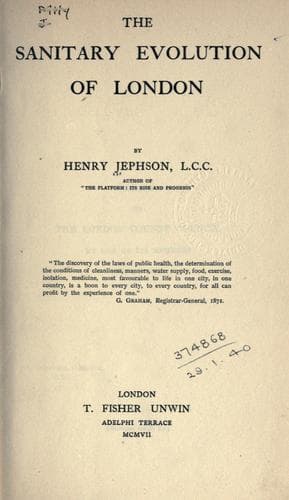
The Sanitary Evolution of LondonJephson, Henry (Henry Lorenzo)
History
The Sanitary Evolution of London
Jephson, Henry (Henry Lorenzo)
Public health -- England -- London
Although by the middle of the nineteenth century there was no portion
of the metropolis into which the mains and pipes of some of the
companies had not been carried, yet, as the companies were under no
compulsion to supply it to all houses, large numbers of houses, and
particularly those of the poorer classes, received no supply. Indeed,
in many parts of London there were whole streets in which not a single
house had water laid on to the premises.
In the district supplied by the New River Company, containing about
900,000 persons, about one-third of the population were unsupplied; and
in the very much smaller area of the Southwark Company's district about
30,000 persons had no supply.
Even in 1850 it was computed that 80,000 houses in London, inhabited by
640,000 persons, were unsupplied with water.
A very large proportion of the people could only obtain water from
stand-pipes erected in the courts or places, and that only at
intermittent periods, and for a very short time in the day; sometimes,
indeed, only on alternate days, and not at all on Sunday.
"To these pipes," wrote a contemporary, "the inhabitants have to
run, leaving their occupation, and collecting their share of this
indispensable commodity in vessels of whatever kind might be at hand.
The water is then kept in the close, ill-ventilated tenements they
occupy until it is required for use."[12]
The quality of the water which was supplied by the companies left
much to be desired. That supplied by the New River Company was, as a
rule, fairly good in quality; but that supplied by the other companies
was very much the reverse. Financial profit being their first and
principal consideration, they got it from where it was obtainable at
least capital outlay or cost, regardless of purity or impurity; and
almost without exception took it from the Thames--"the great sewer of
London"--took it, too, from precisely the places where the river was
foulest and most contaminated by sewage and other filth; and as there
were no filtering beds in which it could have been to some extent
purified before its distribution to householders, its composition can
best be imagined.
Looking at the great river even now in its purified state, as it
sweeps under Westminster Bridge, any one would shudder at the idea of
being compelled to drink its water in its muddy and unfiltered state,
and of one's health and life being dependent on the supply from such a
source. How infinitely more repugnant it must have been when the river
was "the great sewer" of the metropolis.
The great shortage of company-supplied water compelled large numbers
of people to have recourse to the pumps which still existed in
considerable numbers in many parts of London, the water from which was
drawn from shallow wells.
The water of these "slaughter wells," as they have been termed, appears
to have combined all the worst features of water, and to have contained
all the ingredients most dangerous to health.
Public-domain text, read in full here on John Shaqi.
Reviews
Reviews
No reviews yet
Be the first to share your thoughts on this work.
Join the Discussion
Join the discussion
Sign in to leave a comment or review.
Sign InorCreate an account