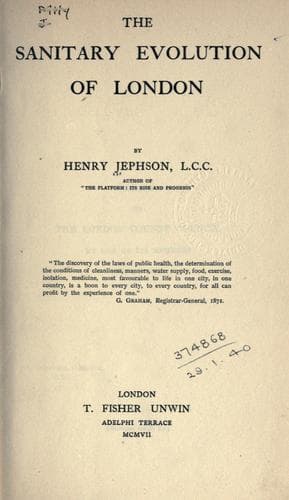
The Sanitary Evolution of LondonJephson, Henry (Henry Lorenzo)
History
The Sanitary Evolution of London
Jephson, Henry (Henry Lorenzo)
Public health -- England -- London
"If," wrote a Medical Officer of Health some years later, "the soil
through which the rain passes be composed of the refuse of centuries,
if it be riddled with cesspools and the remains of cesspools, with
leaky gas-pipes and porous sewers, if it has been the depository of the
dead for generation after generation, the soil so polluted cannot yield
water of any degree of purity."[13]
As all these "ifs" were grim actualities, the water of such wells was
revolting in its impurity and deadly in its composition.
Of Clerkenwell it was indeed stated positively that "the shallow-well
water of the parish received the drainage water of Highgate cemetery,
of numerous burial grounds, and of the innumerable cesspools in the
district."
On the south side of the river the water in most of the shallow wells
was tidal--from the Thames, which is a sufficient description of the
quality thereof--and where people did not live close enough to the
river to draw water from it for their daily wants, they took it from
these tidal wells. Vile as it was, it had to be used in default of any
better.
Where such wells were not available, the water for all household
consumption was taken from tidal ditches which were to all intents
and purposes only open sewers. A contemporary report gives a graphic
picture of this form of supply[14]:--
"In Jacob's Island (in Bermondsey) may be seen at any time of the day
women dipping water, with pails attached by ropes to the backs of the
houses, from a foul, foetid ditch, its banks coated with a compound of
mud and filth, and with offal and carrion--the water to be used for
every purpose, culinary ones not excepted."
An adequate supply of wholesome water has for very long been recognised
as of primary sanitary importance to all populations, but with a
densely crowded town population the need of care as to the quality of
the supplies is peculiarly urgent. And yet, through the indifference
of successive Governments, the people of the great metropolis of
London were most inadequately supplied with water, and what water was
supplied to the great mass of them, or was available for them, was of
the foulest and most dangerous description. The inadequacy of supply
not alone put a constant premium upon dirt and uncleanliness, both in
house and person, but it intensified the evils of the existing sewers
and drains, as without water efficient drainage was impossible. And the
horrible impurity of the water affected disastrously and continuously
the health of the great mass of the people.
Many dire lessons, costing thousands upon thousands of lives, were
needed before it was borne in on the Government of the country that the
arrangements regarding the supply of water for the people of London
required radical amendment.
Much of the health of a city depends upon the width of its
thoroughfares, the free circulation of air in its streets and around
its buildings, and the sound and sanitary construction of its houses.
Public-domain text, read in full here on John Shaqi.
Reviews
Reviews
No reviews yet
Be the first to share your thoughts on this work.
Join the Discussion
Join the discussion
Sign in to leave a comment or review.
Sign InorCreate an account