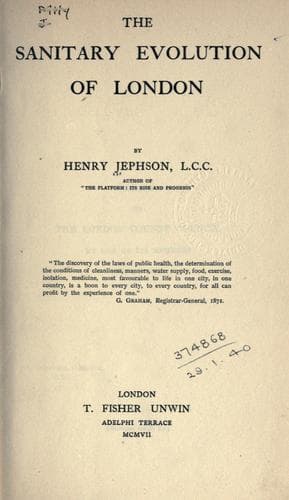
The Sanitary Evolution of LondonJephson, Henry (Henry Lorenzo)
History
The Sanitary Evolution of London
Jephson, Henry (Henry Lorenzo)
Public health -- England -- London
In every one of these respects all the central parts of London were
remarkably defective. The great metropolis had grown, and had been
permitted to grow, mostly at haphazard. Large parks and open spaces
there were in the richer and more well-to-do parts, and some handsome
thoroughfares; but "there were districts in London through which
no great thoroughfares passed, and which were wholly occupied by a
dense population composed of the lowest class of persons, who, being
entirely secluded from the observation and influence of better educated
neighbours, exhibited a state of moral degradation deeply to be
deplored."[15]
Parliament had taken some interest as to the width of the streets, and
had shown some anxiety for improvements in them. Hence, much local
and general legislation was from time to time directed to control the
erection of buildings beyond the regular lines of buildings. Thus the
Metropolitan Paving Act, 1817, contained stringent provisions as to
projections which might obstruct the circulation of air and light, or
be inconvenient or incommodious to passengers along carriage or foot
ways in certain parts of the metropolis.
In 1828 the Act for Consolidating the Metropolis Turnpike Trusts, also,
contained certain restrictive provisions, but these were rendered
futile by the construction put upon its terms by the magistrates.
Again, in 1844, further enactments were made by the Metropolitan
Building Act to restrain projections from buildings; but after a short
administration of its provisions it was found that shops built on the
gardens in front of the houses, or on the forecourts of areas, did
not come within the terms of the Act. And so the Act, in that very
important respect, was useless.
The action of Parliament had been mainly prompted by the necessity for
increased facilities of communication, and by the desire to safeguard
house property from destruction by fire; whilst the most important
of all aspects of the housing of the people--namely, the sanitary
aspect--received no consideration, and was completely ignored as a
thing of no consequence.
But whatever the motive of action by Parliament, the ensuing
legislation was in the main inoperative or ineffective. The resolution
of landowners to secure the highest prices for their property, and the
determination of builders, once they got possession of any land, to
utilise every inch of it for building, and so to make the utmost money
they could out of it, defeated the somewhat loosely drawn enactments.
Means of evading the legislative provisions were promptly discovered,
and, in despite of legislation, builders, architects, and surveyors
of the metropolis were unrestrained in their encroachments upon areas
and forecourts--at times even were successful in breaking the existing
lines of buildings in metropolitan streets or roads by encroachments
which were only discovered too late to be prevented.
Public-domain text, read in full here on John Shaqi.
Reviews
Reviews
No reviews yet
Be the first to share your thoughts on this work.
Join the Discussion
Join the discussion
Sign in to leave a comment or review.
Sign InorCreate an account