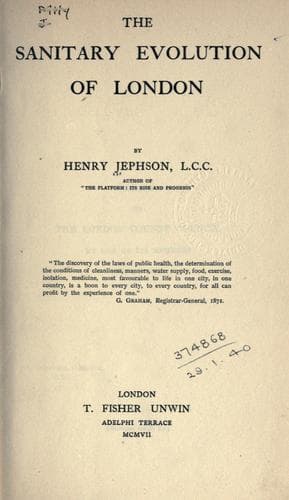
The Sanitary Evolution of LondonJephson, Henry (Henry Lorenzo)
History
The Sanitary Evolution of London
Jephson, Henry (Henry Lorenzo)
Public health -- England -- London
Nor was there anything to prevent houses being built on uncovered
spaces at the backs of existing buildings, thus taking up whatever
air-space had been left between the previous buildings. Hence, great
blocks of ground absolutely covered with buildings, back to back, side
to side, any way so long as a building could by any ingenuity be fitted
in. Hence the culs-de-sac, the small and stifling courts and alleys.
Nor were there any regulations forbidding certain kinds of buildings
which would be injurious to the health of their inhabitants. Hence
the mean and flimsy and insanitary houses which were being erected in
the outer circle of the metropolis, and which wrought havoc with the
health and lives of the people. Hence, too, the erection, on areas and
forecourts, of buildings which narrowed the streets, diminished the
air-spaces and means of ventilation, and destroyed the appearance of
the localities.
And once up they had come to stay; for years were to pass before
the Legislature created any effective means for securing their
amelioration, and for generations they were permitted to exercise
their evil and deadly sway over the people, and to scatter broadcast
throughout the community the seeds of disease and death.
The then existing actual state of the case was summed up by Dr.
Southwood Smith in his evidence before the Select Committee of the
House of Commons in 1840:--
"At present no more regard is paid in the construction of houses to the
health of the inhabitants than is paid to the health of pigs in making
sties for them. In point of fact there is not so much attention paid to
it."
Legislation against some of the evils which had already reached huge
proportions, and which, as London grew, were spreading and developing,
was not alone ineffective, but earlier legislation, in one notorious
Act, had been the direct incentive to, and cause of evils. This was the
Act which imposed a tax upon windows.[16] In effect this Act said to
the builder, "Plan your houses with as few openings as possible. Let
every house be ill-ventilated by shutting out the light and air, and as
a reward for your ingenuity you shall be subject to a less amount of
taxation."[17]
The builder acted upon this counsel, and the tax operated as a premium
upon the omission from a building of every window which could by any
device be spared; with the result that passages, closets, cellars,
and roofs--the very places where mephitic vapours were most apt to
lodge--were left almost entirely without ventilation.[18]
In effect, the window duties compelled multitudes to live and breathe
in darkened rooms and poisoned air, and with a rapidly increasing
population the evils resulting therefrom were being steadily
intensified.
Admirable was the comment passed upon the tax in 1843:--
Public-domain text, read in full here on John Shaqi.
Reviews
Reviews
No reviews yet
Be the first to share your thoughts on this work.
Join the Discussion
Join the discussion
Sign in to leave a comment or review.
Sign InorCreate an account