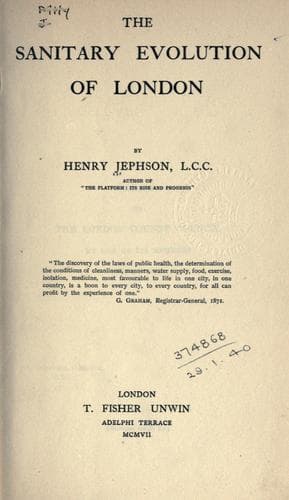
The Sanitary Evolution of LondonJephson, Henry (Henry Lorenzo)
History
The Sanitary Evolution of London
Jephson, Henry (Henry Lorenzo)
Public health -- England -- London
"Health is the capital of the working man, and nothing can justify a
tax affecting the health of the people, and especially of the labouring
community, whose bodily health and strength constitute their wealth,
and, oftentimes, their only possession. It is a tax upon light and air,
a tax more vicious in principle and more injurious in its practical
consequences than a tax upon food."
Not until 1851 was the tax abandoned, but its evil consequences,
wrought in stone and embodied in bricks and mortar, endured many a
long year after.
The existing laws or regulations as to building were wholly inadequate
to secure healthy houses. And there was no public authority with
power to compel attention to the internal condition of houses so as
to prevent their continuance in such a filthy and unwholesome state
as to endanger the health of the public. There was no power to compel
house owners to make drains and carry them to the common sewer where
it existed. No persons were appointed to carry into effect such
communication. No persons were authorised to make inspection and to
report upon these matters.
The poor, or, indeed, the working classes generally, were powerless
to alter or amend the construction of the dwellings in which they
were compelled to reside, still less to alter their surroundings.
Any improvement in the condition of their dwellings could only be by
voluntary action on the part of the landlords, or of interference
by Government to compel that measure of justice to the poor, and of
economy to the ratepayers.
Parliament failed to interfere with any effect; and as to the landlords
or house-owners, their interest ran all the other way.
Few persons of large capital built houses as a speculation, or had
anything to do with them. Many, however, who were desirous of making
the highest possible interest on their money acquired either freehold
or leasehold land, and built cheap and ill-constructed houses upon it
without the least regard to the health of the future inmates.
And the small landlords were often the most unscrupulous with regard to
the condition of the houses they let, and exacted the highest rents.
Inasmuch as this freedom as regarded house construction had been going
on almost from time immemorial, it was not only the newly-built houses
which were bad. Earlier built houses had rapidly fallen into disrepair
and semi-ruin, and were steadily going from bad to worse, and becoming
ever less and less suitable for human dwellings.
The following description[19] of parts of St. Giles' and Spitalfields
shows what, under a state of freedom as to building, had been attained
to in 1840, and is typical of what so extensively prevailed in the
central parts of London:--
Public-domain text, read in full here on John Shaqi.
Reviews
Reviews
No reviews yet
Be the first to share your thoughts on this work.
Join the Discussion
Join the discussion
Sign in to leave a comment or review.
Sign InorCreate an account