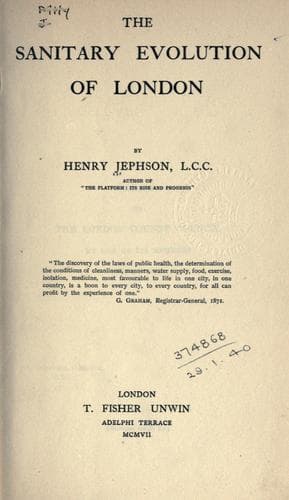
The Sanitary Evolution of LondonJephson, Henry (Henry Lorenzo)
History
The Sanitary Evolution of London
Jephson, Henry (Henry Lorenzo)
Public health -- England -- London
"Those districts are composed almost entirely of small courts, very
small and very narrow, the access to them being only under gateways;
in many cases they have been larger courts originally, and afterwards
built in again with houses back to back, without any outlet behind, and
only consisting of two rooms, and almost a ladder for a staircase; and
those houses are occupied by an immense number of inhabitants; they are
all as dark as possible, and as filthy as it is possible for any place
to be, arising from want of air and light."
Here is another description--that of "Christopher Court," a cul-de-sac
in Whitechapel--given, in 1848, by Dr. Allison, one of the surgeons of
the Union:--
"This was one of the dirtiest places which human beings ever
visited--the horrible stench which polluted the place seemed to be
closed in hermetically among the people; not a breath of fresh air
reached them--all was abominable."
It is needless to multiply instances. There is a dreadful unanimity
of testimony from all parts of London as to the miserable character
and condition of the houses in which in the middle of the nineteenth
century the industrial and the lower classes were forced to live;
the deficiency or total absence of drainage, the universal filth and
abomination of every kind, the fearful overcrowding, the ravages
of every type of disease, and the absolute misery in which masses
struggled for existence.
The density of houses upon an area has long been recognised as one of
the great contributing causes to the ill-health of a community, but
when coupled with the overcrowding of human beings in those houses, the
combined results are always disastrous in the extreme.
Overcrowding had been a long-standing evil in London; had existed far
back in history.
As London had grown, the evil had grown; and about the middle of the
last century it was immeasurably greater than ever before, and its
disastrous consequences were on a vastly larger scale.
The great economic forces which resulted, in certain districts of
London, in the destruction of houses and great clearances of ground,
had largely reduced the available accommodation for dwellings, and the
expelled inhabitants, chained to the locality by the fact of their
livelihood being dependent upon their residence being close by, were
forced to invade the yet remaining places in the neighbourhood suited
to their means. As the circle of possible habitations contracted,
while the numbers seeking accommodation therein increased, a larger
population was crowded into an ever-diminishing number of houses.
It was also a most unfortunate but apparently inevitable consequence
that once a beginning was made to improve some of the streets and
thoroughfares of London, and to substitute in any district a better
class of houses and shops for those actually existing, the improvements
necessarily involved increased overcrowding in that particular locality
and in those adjoining it. But so it was.
Public-domain text, read in full here on John Shaqi.
Reviews
Reviews
No reviews yet
Be the first to share your thoughts on this work.
Join the Discussion
Join the discussion
Sign in to leave a comment or review.
Sign InorCreate an account