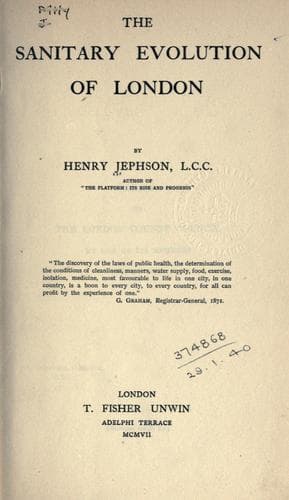
The Sanitary Evolution of LondonJephson, Henry (Henry Lorenzo)
History
The Sanitary Evolution of London
Jephson, Henry (Henry Lorenzo)
Public health -- England -- London
House drainage into the sewers was, however, either lamentably
deficient or non-existent, and cesspools abounded--abounded so freely
that "parts of the City might be described as having a cesspool-city
excavated beneath it."
"It requires," reported Dr. Simon to his employers, "little medical
knowledge to understand that animals will scarcely thrive in an
atmosphere of their own decomposing excrements; yet such, strictly and
literally speaking, is the air which a very large proportion of the
inhabitants of the City are condemned to breathe.... In some instances,
where the basement storey of a house is tenanted, the cesspool lies,
perhaps merely boarded over, close beneath the feet of a family of
human beings whom it surrounds uninterruptedly, whether they wake or
sleep, with its foetid pollution and poison."
For such evils, and such a state of things, he said, house drainage,
with effective water supply, were the remedies which could alone avail;
and it was only in the Session of 1848 that the authority to secure and
enforce these remedies was vested by the Legislature in any public body
whatsoever. The City was fortunately included, but the metropolis, with
its two and a half millions of inhabitants, was unfortunately not.
The unrestricted supply of water, he pointed out, was the first
essential of decency, of comfort, and of health; no civilisation of the
poorer classes could exist without it; and any limitation to its use in
the metropolis was a barrier which must maintain thousands in a state
of the most unwholesome filth and degradation.
Even in the City, however, the supply of water was but "a fraction of
what it should have been, and thousands of the population inhabited
houses which had no supply of it."
Nor was what was supplied by the Water Companies much to boast of.
"The waters were conducted from their sources in open channels; they
received in a large measure the surface-washing, the drainage, and
even the sewage of the country through which they passed; they derived
casual impurities from bathers and barges, and on their arrival were,
after a short subsidence in reservoirs, distributed without filtration
to the public."
In some cases the scanty distribution was from a stand-pipe in a
court or alley, for a very short time of the day. In other cases the
water was delivered into butts or cisterns. Their condition is thus
described:--
Public-domain text, read in full here on John Shaqi.
Reviews
Reviews
No reviews yet
Be the first to share your thoughts on this work.
Join the Discussion
Join the discussion
Sign in to leave a comment or review.
Sign InorCreate an account