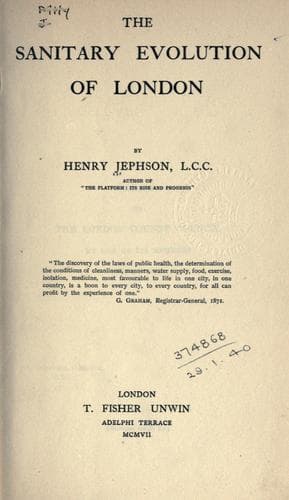
The Sanitary Evolution of LondonJephson, Henry (Henry Lorenzo)
History
The Sanitary Evolution of London
Jephson, Henry (Henry Lorenzo)
Public health -- England -- London
"The object of the resolution he was proposing was to bring the
Metropolis within the provisions of the Public Health Act, most
absurdly and monstrously excluded from its operation.... Infancy was
made stunted, ugly, and full of pain; maturity made old; and old age
imbecile.
"He knew of many places in London unsurpassed in the accumulated
horrors of their long neglect by the dirtiest old spots in the dirtiest
old towns under the worst old governments in Europe.
"The principal objectors to the improvements proposed were divided into
two classes.
"The first consisted of the owners of small tenements, men who pushed
themselves to the front of Boards of Guardians and parish Vestries,
and were clamorous about the rating of their property; the other class
was composed of gentlemen, more independent and less selfish, who had
a weak leaning towards self-government. The first class generally
proceeded upon the supposition that the compulsory improvement of their
property when exceedingly defective would be very expensive....
"No one," he went on to say, "who had any knowledge of the poor could
fail to be deeply affected by their patience and their sympathy with
one another--by the beautiful alacrity with which they helped each
other in toil, in the day of suffering, in the hour of death.
"It hardly ever happened that any case of extreme protracted
destitution found its way into the public prints without our reading
at the same time of some ragged Samaritan sharing his last loaf or
spending his last penny to relieve the poor miserable in the room
upstairs or in the cellar underground. It was to develop in the poor
people the virtue which nothing could eradicate, to raise them in the
social scale as they should be raised, to lift them from a condition
into which they did not allow their beast to sink, ... to cleanse the
foul air for the passage of Christianity and education throughout the
land, that the meeting was assembled. The object of their assembly was
simply to help to set that right which was wrong before God and before
man."
The realisation of this object, noble as it was, was not easily
attainable.
The Vicar of St. Martin-in-the-Fields said that "the difficulty of
legislation in these matters was to hit the medium between the rights
of property and the rights of humanity." He might have added, with
truth, that the difficulty had so far been met by sacrificing the
rights of humanity to the rights of property.
Lord Ashley had pointed out that they "had to contend with ignorance,
indifference, selfishness, and interest;" or as Lord Robert Grosvenor
more vigorously expressed it, in a phrase which should live in history
as giving the key to the mystery of the slow sanitary evolution of this
great city, they had to contend against "vested interests in filth and
dirt."
One thing was already absolutely clear, that it was hopeless to expect
anything from the spontaneous action of land-owners or house-owners.
Public-domain text, read in full here on John Shaqi.
Reviews
Reviews
No reviews yet
Be the first to share your thoughts on this work.
Join the Discussion
Join the discussion
Sign in to leave a comment or review.
Sign InorCreate an account