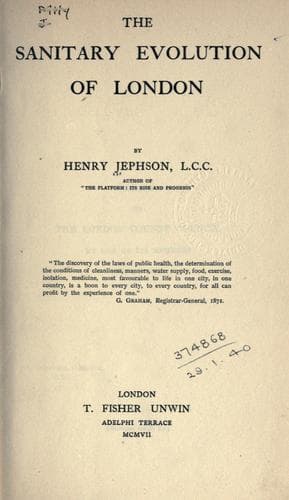
The Sanitary Evolution of LondonJephson, Henry (Henry Lorenzo)
History
The Sanitary Evolution of London
Jephson, Henry (Henry Lorenzo)
Public health -- England -- London
"They knew it was quite impossible," said the Bishop of Chichester, "to
bring the owners of even one small court or alley, much less the owners
or occupiers of any large district, to concur in any measure for the
general good of their particular locality."
The fact was that nothing but the imperative directions of the law
would secure the removal of evils or curtail the practice of infamous
abuses--and even when the law was enacted for their remedy, nothing
but its rigorous enforcement with adequate penalties would make it
effective.
As the result of the meeting, a deputation waited on Lord John Russell,
the then Prime Minister. His reply was not encouraging.
"In this city," he said, "there is very naturally and properly great
jealousy of any interference either with local rights or individual
will and freedom from control."
That great jealousy proved to be so powerful that nothing was
attempted by the Government except an abortive effort to deal with the
loathsome and insanitary evils of intramural interments where vested
interests were neither powerful nor loud voiced.
The Act was so defective that it never came into operation, and two
more years elapsed before the Government again essayed to deal with the
subject. And in the meanwhile that most horrible evil was permitted to
work its will upon the dwellers in the metropolis.
To the enthusiasm of an individual, and not of the Government, was due
the first effective attempt to grapple with one of the widespread,
deep-seated evils which were working such havoc among the people. The
most disastrous and vicious forms of overcrowding were at the time to
be found in the so-called Common Lodging Houses--the sink of insanitary
abominations.
These were the temporary and casual abodes of the dregs of London
humanity--of the tramps, and the unfortunates, and the mendicants
and criminals, male and female--when they could afford the penny or
pence to pay for their night's lodging. In most cases these houses
were low brothels and hotbeds of crime and moral degeneracy, their
foul and filthy condition making them great sources and propagators of
contagious and loathsome diseases.
In the "City" the authorities had power to regulate and control them.
Not so, however, in the metropolis. There, no one had any authority in
the matter, nor was there any authority for any one to have.
Lord Ashley, truly discerning that the one and only way of dealing with
this evil was by regulation and constraint, introduced a Bill[43] and
actually carried it through Parliament, and two years later got another
Act[44] embodying amendments which made it more effective.
What the Common Lodging House owner or keeper--anxious to secure the
utmost profits from his property and regardless of all consequences to
others--would not do, he was, by those Acts, made to do.
Public-domain text, read in full here on John Shaqi.
Reviews
Reviews
No reviews yet
Be the first to share your thoughts on this work.
Join the Discussion
Join the discussion
Sign in to leave a comment or review.
Sign InorCreate an account