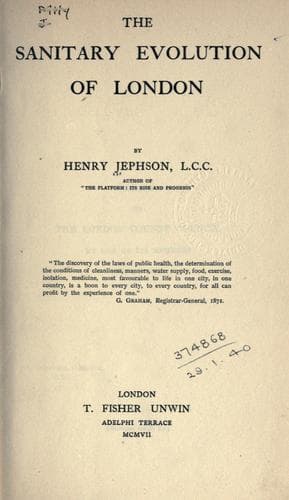
The Sanitary Evolution of LondonJephson, Henry (Henry Lorenzo)
History
The Sanitary Evolution of London
Jephson, Henry (Henry Lorenzo)
Public health -- England -- London
The houses which he devoted to this purpose, solely for his own
profit, were placed under the control and inspection of the police,
and had to be registered as "Common Lodging Houses." Overcrowding in
them was checked by restricting the number of inmates who might be
in each room; regulations (confirmed by a Secretary of State) were
made, and steadily enforced, for the separation of the sexes; for the
proper cleansing of the houses; and for compelling the keeper to give
immediate notice of fever or any contagious or infectious disease
occurring therein. The accumulation of refuse was to be prevented,
and provision had to be made for adequate sanitary accommodation, for
better drainage, and for sufficient water supply.
A very brief experience showed that great practical benefits resulted
from thus regulating these houses, and the amount of sickness and
mortality in them became astonishingly small, considering the character
of their inmates and the localities where they were situated; and
inasmuch as the number of such houses was nearly 5,000, and the
population in them about 80,000, the benefit was a really substantial
one.
How obstinate and pertinacious was the opposition of house-owners, or
middlemen, to regulation and supervision of any kind is illustrated
by a case reported by the Assistant Police Commissioner.[45] The
owner of certain premises in St. Giles' had been often applied to,
without success, to remedy some gross sanitary defects therein which
had resulted in the loss of life by fever. Brought to bay at last,
at the Police Court, and ordered to remedy the evil, he said that he
was willing to do all in his power to abate the nuisance ... but, "he
thought he ought not to be dictated to as to the way his property was
to be managed." His words embodied the predominant spirit of the time.
"There are," wrote the Assistant Police Commissioner in commenting upon
this case, "owners of property whom nothing but the strong arm of the
law can move."
Unfortunately the Act did not go far enough. Single rooms occupied by
families did not come within its scope. They constituted an enormous
proportion of the habitations of the people, and they were allowed to
continue the prolific cause of sanitary evils and of physical and moral
degradation.
Limited in its scope though the Act was, it afforded nevertheless
one great object lesson--the lesson which since that time has been
consistently preached by all who had actual experience as regarded the
sanitary condition of the people of London--the lesson that the worst
of the sanitary and social evils could only be effectually grappled
with, on the one side by the supervision and regulation and constant
inspection of the houses in which the poorer classes lived, and upon
the other side by insistent compulsion of house-owners to maintain a
certain standard of sanitation and cleanliness in those houses.
Public-domain text, read in full here on John Shaqi.
Reviews
Reviews
No reviews yet
Be the first to share your thoughts on this work.
Join the Discussion
Join the discussion
Sign in to leave a comment or review.
Sign InorCreate an account