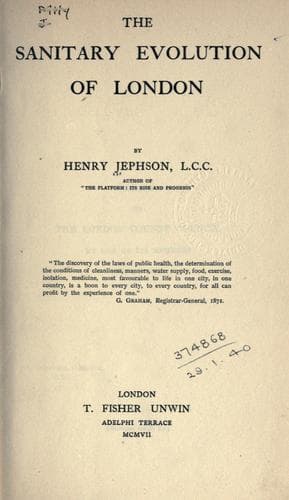
The Sanitary Evolution of LondonJephson, Henry (Henry Lorenzo)
History
The Sanitary Evolution of London
Jephson, Henry (Henry Lorenzo)
Public health -- England -- London
The "City" was virtually the centre of London--the centre of its
wealth, its industry, its geographical extent--a precisely defined area
of some 720 acres, or about one square mile in extent, and originally
surrounded by walls. Its boundaries had been fixed at an early period
of our history, and had never been extended or enlarged. So densely was
it covered with houses at the beginning of the nineteenth century, and
so fully peopled, that there was practically no room for more, either
of houses or people; and from then to the middle of that century its
population was stationary--being close upon 128,000 at each of those
periods.
Apart altogether from political influences, there were in the "City"
powerful economic forces at work which profoundly affected the
condition and circumstances of the people, not only of the "City," but
of London.
These, which were by no means so evident at one time, became more and
more pronounced as time went on.
All through the earlier part of the nineteenth century England was
attaining to world pre-eminence by her commerce, her manufactures, and
her wealth. The end of the great war with France saw her with a firm
grip of all the commercial markets of the world. Her merchants pushed
their trade in every quarter of the globe--her ships enjoyed almost a
monopoly of the carrying trade of the world.
In this progress to greatness London took the foremost part, and
became the greatest port and trade emporium of the kingdom, a great
manufacturing city, and the financial centre of the world's trade.
It was upon this commerce that the prosperity and glory of London were
built: it was by this commerce that the great bulk of the people gained
their livelihood, and that a broad highway was opened to comfort,
to opulence, and power. And so the commercial spirit--the spirit of
acquiring and accumulating wealth--got ever greater possession of
London.
That spirit had long been a great motive power in London; it became
more and more so as the century wore on, until almost everything was
subordinated to it.
That indisputable fact must constantly be borne in mind as one reviews
the sanitary and social condition of the people of London at and
since that time. Other constant factors there were, also exercising
vast influence--the constant factors of human passions and human
failings--but widespread as were their effects, they were second to the
all-powerful, the all-impelling motive and unceasing desire--commercial
prosperity and success.
Synchronous with the rise in importance of the port of London, and
with its trade and business assuming ever huger volume and variety, a
noteworthy transformation took place.
The "City," by the very necessities of its enormous business, became
gradually more and more a city of offices and marts, of warehouses and
factories, of markets and exchanges, and houses long used as residences
were pulled down, and larger and loftier ones erected in their place
for business purposes.
Public-domain text, read in full here on John Shaqi.
Reviews
Reviews
No reviews yet
Be the first to share your thoughts on this work.
Join the Discussion
Join the discussion
Sign in to leave a comment or review.
Sign InorCreate an account