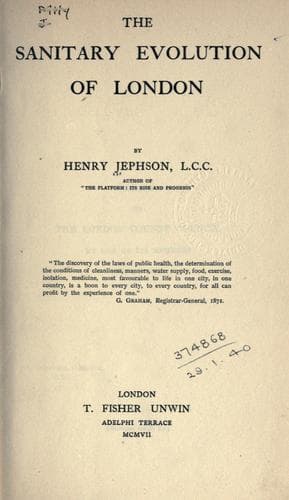
The Sanitary Evolution of LondonJephson, Henry (Henry Lorenzo)
History
The Sanitary Evolution of London
Jephson, Henry (Henry Lorenzo)
Public health -- England -- London
In some places, moreover, ground was entirely cleared of houses for the
construction of docks, or for the erection of great railway termini.
How marked were the effects of these changes is evidenced by the fact
that from 17,190 inhabited houses in the "City" in 1801, the number had
sunk to 14,575 in 1851.
The explanation was the simple economic one, that land in the "City"
yielded a much larger income when let for business than for residential
purposes. Offices and warehouses were absolutely essential in the
"City" for business. What did it matter if people had to look for a
residence in some other place? London was large. They could easily find
room. And the process, without control of any sort or kind, and wholly
unimpeded by legislation or governmental regulation, went on quite
naturally--entailing though it did consequences of the very gravest
character, then quite unthought of, or, if thought of, ignored or
regarded as immaterial.
This then was, at that time, and still is, one of the great, if
not indeed the greatest of the economic forces at work which has
unceasingly dominated the housing of the people not only in the "City,"
but in the metropolis outside and surrounding the "City," and, in
dominating their housing, powerfully affected also their sanitary and
social condition.
The "City" was in the enjoyment of a powerful local governing
body--namely, the Lord Mayor and Corporation, or Common Council,
elected annually by the ratepayers; and numerous Acts of Parliament and
Royal Charters had conferred sundry municipal powers upon them.
For that important branch of civic requirements--the regulation of
the thoroughfares and the construction of houses and buildings--they
had certain powers. The vastly more important sphere of civic
welfare--namely, the matters affecting the sanitary condition of the
inhabitants--was delegated by the Corporation to a body called the
Commissioners of Sewers, annually elected by the Common Council out of
their own body, some ninety in number. And these Commissioners had,
in effect, authority in the City, directly or indirectly, over nearly
every one of the physical conditions which were likely to affect the
health or comfort of its inhabitants. They could also appoint a Medical
Officer of Health to inform and advise them upon public health matters,
and Inspectors to enforce the laws and regulations.
The "City" was thus in happy possession of a powerful local authority,
and a large system of local government. And it stood in stately
isolated grandeur, proud of, and satisfied with, its dignity, and
privileges, and wealth; glorying in its own importance and splendour;
content with its own system of government, and its powers for
administering its municipal affairs, and indifferent to the existence
of the greater London which had grown up around it, and which was ever
becoming greater.
Greater indeed. The population of the "City" in 1851 was 128,000; that
of the metropolis not far short of 2,500,000.
Public-domain text, read in full here on John Shaqi.
Reviews
Reviews
No reviews yet
Be the first to share your thoughts on this work.
Join the Discussion
Join the discussion
Sign in to leave a comment or review.
Sign InorCreate an account