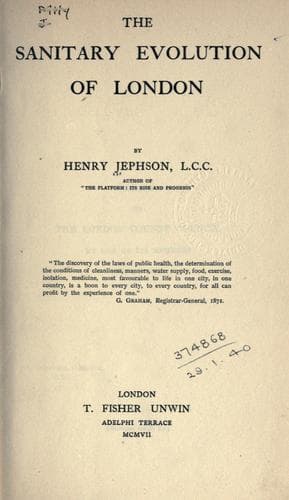
The Sanitary Evolution of LondonJephson, Henry (Henry Lorenzo)
History
The Sanitary Evolution of London
Jephson, Henry (Henry Lorenzo)
Public health -- England -- London
The number of inhabited houses in the "City" was hundreds short of
15,000. In the metropolis it was over 300,000.
The "City" was 720 acres in extent: what in 1855 was regarded as the
metropolis was about 75,000 acres in extent.
And here, with no visible boundary of separation between them, were
what were still "Parishes," but what were in reality great towns; not
merely merged or rapidly merging into each other, but already merged
into one great metropolis. Some of them even had a greater population
than the "City" itself. St. Pancras, for instance, with 167,000
persons; St. Marylebone with 157,000, and Lambeth with 139,000.
Of that greater London--or, in effect, of London itself--there is a
complicated and tangled story to tell.
Long before the middle of the nineteenth century had been reached, the
time had passed when the "City" could contain the trade, and commerce,
and manufactures, and business, which had grown up. They had overflowed
into London outside the walls, and just as in the "City" the great
economic forces produced certain definite changes in the circumstances
and sanitary condition of the people living therein, so, in the greater
London, the commercial spirit radiating gradually outwards, produced
precisely similar results, only on a far wider scale, and with more
potent effect.
Trade, and commerce, and wealth, and population, were increasing by
leaps and bounds; and like the rings which year by year are added to
the trunk of a tree, so year by year, decade by decade, London--the
metropolis--spread out, and grew, and grew. From something under one
million of inhabitants in 1801, the population increased to nearly two
and a half millions in 1851, partly by natural increase, due to the
number of those who were born being greater than of those who died,
partly by immigration from the country.
This was London, in the large sense of the title--London, the great
metropolis which had never received recognition by the law as one
great entity, and whose boundaries had never been fixed, either by
enactment, charter, or custom.[5]
Dependent as is the public health, or sanitary and social condition
of the people, upon the circumstances in which they find themselves
placed, and the economic forces which are constantly at work moulding
those circumstances, it is in as great a degree dependent on the system
of local government in existence at the time, upon the scope and
efficacy of the laws entrusted to the local authorities to administer,
and upon the administration of those laws by those authorities.
As for local government--unlike the "City"--this greater London was
without form and almost void. With the exception of the Poor Law
Authority--the Boards of Guardians--whose sphere of duty was distinctly
limited, there was, outside the boundaries of the "City," not even the
framework of a system of such government; and the confusion and chaos
became ever greater as years went on and London grew.
Public-domain text, read in full here on John Shaqi.
Reviews
Reviews
No reviews yet
Be the first to share your thoughts on this work.
Join the Discussion
Join the discussion
Sign in to leave a comment or review.
Sign InorCreate an account