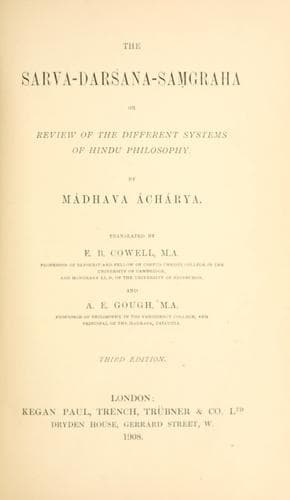
The Sarva-Darsana-Samgraha: Or, Review of the Different Systems of Hindu PhilosophyMadhava
ReligionEastern
The Sarva-Darsana-Samgraha: Or, Review of the Different Systems of Hindu Philosophy
Madhava
Philosophy, Hindu; Philosophy, Indic
But we cannot accept this objection as valid, since these phenomena
can all be produced spontaneously from the inherent nature of things.
Thus it has been said--
The fire is hot, the water cold, refreshing cool the breeze of morn;
By whom came this variety? from their own nature was it born.
And all this has been also said by Bṛihaspati--
There is no heaven, no final liberation, nor any soul in another world,
Nor do the actions of the four castes, orders, &c., produce any real
effect.
The Agnihotra, the three Vedas, the ascetic's three staves, and
smearing one's self with ashes,
Were made by Nature as the livelihood of those destitute of knowledge
and manliness.
If a beast slain in the Jyotishṭoma rite will itself go to heaven,
Why then does not the sacrificer forthwith offer his own father?[26]
If the Śráddha produces gratification to beings who are dead,
Then here, too, in the case of travellers when they start, it is
needless to give provisions for the journey.
If beings in heaven are gratified by our offering the Śráddha here,
Then why not give the food down below to those who are standing on the
housetop?
While life remains let a man live happily, let him feed on ghee even
though he runs in debt;
When once the body becomes ashes, how can it ever return again?
If he who departs from the body goes to another world,
How is it that he comes not back again, restless for love of his
kindred?
Hence it is only as a means of livelihood that Brahmans have
established here
All these ceremonies for the dead,--there is no other fruit anywhere.
The three authors of the Vedas were buffoons, knaves, and demons.
All the well-known formulæ of the pandits, jarpharí, turpharí, &c.[27]
And all the obscene rites for the queen commanded in the Aśwamedha,
These were invented by buffoons, and so all the various kinds of
presents to the priests,[28]
While the eating of flesh was similarly commanded by night-prowling
demons.
Hence in kindness to the mass of living beings must we fly for refuge
to the doctrine of Chárváka. Such is the pleasant consummation.
E. B. C.
FOOTNOTES:
[Footnote 6: "Śaṅkara, Bháskara, and other commentators name the
Lokáyatikas, and these appear to be a branch of the Sect of Chárváka"
(Colebrooke). Lokáyata may be etymologically analysed as "prevalent in
the world" (_loka_ and _áyata_). Laukáyatika occurs in Páṇini's
ukthagaṇa.]
Public-domain text, read in full here on John Shaqi.
Reviews
Reviews
No reviews yet
Be the first to share your thoughts on this work.
Join the Discussion
Join the discussion
Sign in to leave a comment or review.
Sign InorCreate an account