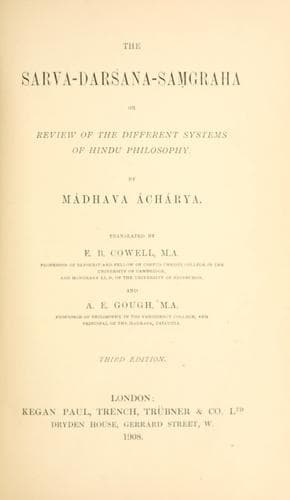
The Sarva-Darsana-Samgraha: Or, Review of the Different Systems of Hindu PhilosophyMadhava
ReligionEastern
The Sarva-Darsana-Samgraha: Or, Review of the Different Systems of Hindu Philosophy
Madhava
Philosophy, Hindu; Philosophy, Indic
Then again _comparison_,[19] &c., must be utterly rejected as the
means of the knowledge of the universal proposition, since it is
impossible that they can produce the knowledge of the unconditioned
connection [_i.e._, the universal proposition], because their end is
to produce the knowledge of quite another connection, viz., the
relation of a name to something so named.
Again, this same absence of a condition,[20] which has been given as
the definition of an invariable connection [_i.e._, a universal
proposition], can itself never be known; since it is impossible to
establish that all conditions must be objects of perception; and
therefore, although the absence of perceptible things may be itself
perceptible, the absence of non-perceptible things must be itself
non-perceptible; and thus, since we must here too have recourse to
inference, &c., we cannot leap over the obstacle which has already
been planted to bar them. Again, we must accept as the definition of
the condition, "it is that which is reciprocal or equipollent in
extension[21] with the major term though not constantly accompanying
the middle." These three distinguishing clauses, "not constantly
accompanying the middle term," "constantly accompanying the major
term," and "being constantly accompanied by it" [_i.e._, reciprocal],
are needed in the full definition to stop respectively three such
fallacious conditions, in the argument to prove the non-eternity of
sound, as "being produced," "the nature of a jar," and "the not
causing audition;"[22] wherefore the definition holds,--and again it
is established by the śloka of the great Doctor beginning
_samásama_.[23]
But since the knowledge of the condition must here precede the
knowledge of the condition's absence, it is only when there is the
knowledge of the condition, that the knowledge of the universality of
the proposition is possible, _i.e._, a knowledge in the form of such a
connection between the middle term and major term as is distinguished
by the absence of any such condition; and on the other hand, the
knowledge of the condition depends upon the knowledge of the
invariable connection. Thus we fasten on our opponents as with
adamantine glue the thunderbolt-like fallacy of reasoning in a circle.
Hence by the impossibility of knowing the universality of a
proposition it becomes impossible to establish inference, &c.[24]
The step which the mind takes from the knowledge of smoke, &c., to the
knowledge of fire, &c., can be accounted for by its being based on a
former perception or by its being an error; and that in some cases
this step is justified by the result, is accidental just like the
coincidence of effects observed in the employment of gems, charms,
drugs, &c.
From this it follows that fate, &c.,[25] do not exist, since these can
only be proved by inference. But an opponent will say, if you thus do
not allow adṛishṭa, the various phenomena of the world become
destitute of any cause.
Public-domain text, read in full here on John Shaqi.
Reviews
Reviews
No reviews yet
Be the first to share your thoughts on this work.
Join the Discussion
Join the discussion
Sign in to leave a comment or review.
Sign InorCreate an account