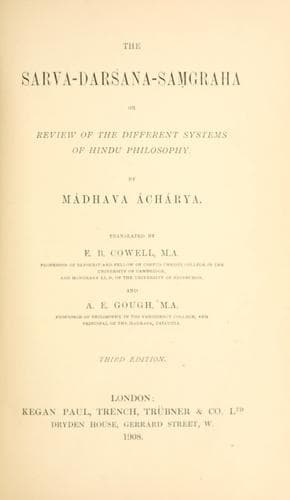
The Sarva-Darsana-Samgraha: Or, Review of the Different Systems of Hindu PhilosophyMadhava
ReligionEastern
The Sarva-Darsana-Samgraha: Or, Review of the Different Systems of Hindu Philosophy
Madhava
Philosophy, Hindu; Philosophy, Indic
[Footnote 7: _Kiṇwa_ is explained as "drug or seed used to produce
fermentation in the manufacture of spirits from sugar, bassia, &c."
Colebrooke quotes from Śaṅkara: "The faculty of thought results from a
modification of the aggregate elements in like manner as sugar with a
ferment and other ingredients becomes an inebriating liquor; and as
betel, areca, lime, and extract of catechu chewed together have an
exhilarating property not found in those substances severally."]
[Footnote 8: Of course Śaṅkara, in his commentary, gives a very
different interpretation, applying it to the cessation of individual
existence when the knowledge of the Supreme is once attained. Cf.
Śabara's Comm. Jaimini Sút., i. i. 5.]
[Footnote 9: I take _kaṇa_ as here equal to the Bengali _kunṛ_. Cf.
Atharva-V., xi. 3, 5. _Aśváḥ kaṇá gávas taṇḍulá maśakás tusháḥ._]
[Footnote 10: See Nyáya Sútras, ii. 57.]
[Footnote 11: _I.e._, personality and fatness, &c.]
[Footnote 12: I read _dehe_ for _dehaḥ_.]
[Footnote 13: Literally, "must be an attribute of the subject and have
invariable concomitance (_vyápti_)."]
[Footnote 14: For the _sandigdha_ and _niśchita upádhi_ see Siddhánta
Muktávali, p. 125. The former is accepted only by one party.]
[Footnote 15: Literally, the knowledge of the invariable concomitance
(as of smoke by fire).]
[Footnote 16: The attributes of the class are not always found in
every member,--thus idiots are men, though man is a rational animal;
and again, this particular smoke might be a sign of a fire in some
other place.]
[Footnote 17: See Sáhitya Darpaṇa (Ballantyne's trans. p. 16), and
Siddhánta-M., p. 80.]
[Footnote 18: The properly logical, as distinguished from the
rhetorical, argument.]
[Footnote 19: "_Upamána_ or the knowledge of a similarity is the
instrument in the production of an inference from similarity. This
particular inference consists in the knowledge of the relation of a
name to something so named." Ballantyne's Tarka Sangraha.]
[Footnote 20: The upádhi is the condition which must be supplied to
restrict a too general middle term, as in the inference "the mountain
has smoke because it has fire," if we add wet fuel as the condition of
the fire, the middle term will be no longer too general. In the case
of a true vyápti, there is, of course, no upádhi.]
[Footnote 21: 'Αντιστρἑφει (Pr. Anal., ii. 25). We have here our A
with distributed predicate.]
Public-domain text, read in full here on John Shaqi.
Reviews
Reviews
No reviews yet
Be the first to share your thoughts on this work.
Join the Discussion
Join the discussion
Sign in to leave a comment or review.
Sign InorCreate an account