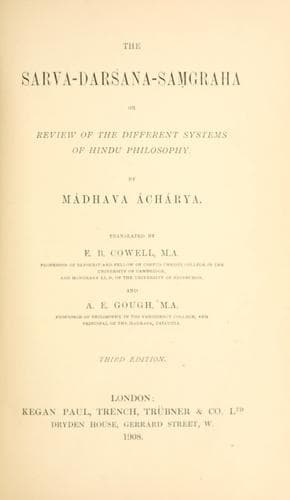
The Sarva-Darsana-Samgraha: Or, Review of the Different Systems of Hindu PhilosophyMadhava
ReligionEastern
The Sarva-Darsana-Samgraha: Or, Review of the Different Systems of Hindu Philosophy
Madhava
Philosophy, Hindu; Philosophy, Indic
[Footnote 22: If we omitted the first clause, and only made the upádhi
"that which constantly accompanies the major term and is constantly
accompanied by it," then in the Naiyáyika argument "sound is
non-eternal, because it has the nature of sound," "being produced"
would serve as a Mímáṃsaka upádhi, to establish the _vyabhichára_
fallacy, as it is reciprocal with "non-eternal;" but the omitted
clause excludes it, as an upádhi must be consistent with _either_
party's opinions, and, of course, the Naiyáyika maintains that "being
produced" _always_ accompanies the class of sound. Similarly, if we
defined the upádhi as "not constantly accompanying the middle term and
constantly accompanied by the major," we might have as an upádhi "the
nature of a jar," as this is never found with the middle term (the
class or nature of sound only residing in sound, and that of a jar
only in a jar), while, at the same time, wherever the class of jar is
found there is also found non-eternity. Lastly, if we defined the
upádhi as "not constantly accompanying the middle term, and constantly
accompanying the major," we might have as a Mímáṃsaka upádhi "the not
causing audition," _i.e._, the not being apprehended by the organs of
hearing; but this is excluded, as non-eternity is not always found
where this is, ether being inaudible and yet eternal.]
[Footnote 23: This refers to an obscure śloka of Udayanáchárya, "where
a reciprocal and a non-reciprocal universal connection (_i.e._,
universal propositions which severally do and do not distribute their
predicates) relate to the same argument (as _e.g._, to prove the
existence of smoke), there that non-reciprocating term of the second
will be a fallacious middle, which is not invariably accompanied by
the other reciprocal of the first." Thus "the mountain has smoke
because it has fire" (here fire and smoke are non-reciprocating, as
fire is not found invariably accompanied by smoke though smoke is by
fire), or "because it has fire from wet fuel" (smoke and fire from wet
fuel being reciprocal and always accompanying each other); the
non-reciprocating term of the former (fire) will give a fallacious
inference, because it is also, of course, not invariably accompanied
by the special kind of fire, that produced from wet fuel. But this
will not be the case where the non-reciprocating term _is_ thus
invariably accompanied by the other reciprocal, as "the mountain has
fire because it has smoke;" here, though fire and smoke do not
reciprocate, yet smoke will be a true middle, because it is invariably
accompanied by heat, which is the reciprocal of fire. I wish to add
here, once for all, that I own my explanation of this, as well as many
another, difficulty in the Sarva-darśana-śaṅgraha to my old friend and
teacher, Paṇḍit Maheśa Chandra Nyáyaratna, of the Calcutta Sanskrit
College.]
Public-domain text, read in full here on John Shaqi.
Reviews
Reviews
No reviews yet
Be the first to share your thoughts on this work.
Join the Discussion
Join the discussion
Sign in to leave a comment or review.
Sign InorCreate an account