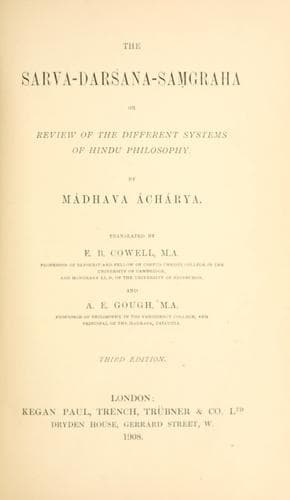
The Sarva-Darsana-Samgraha: Or, Review of the Different Systems of Hindu Philosophy — John Shaqi
The Sarva-Darsana-Samgraha: Or, Review of the Different Systems of Hindu PhilosophyMadhava
ReligionEastern
The Sarva-Darsana-Samgraha: Or, Review of the Different Systems of Hindu Philosophy
Madhava
Philosophy, Hindu; Philosophy, Indic
[Footnote 24: Cf. Sextus Empiricus, P. Hyp. ii. In the chapter on the
Buddhist system _infra_, we have an attempt to establish the authority
of the universal proposition from the relation of cause and effect or
genus and species.]
[Footnote 25: _Adṛishṭa_, _i.e._, the merit and demerit in our actions
which produce their effects in future births.]
[Footnote 26: This is an old Buddhist retort. See Burnouf, Introd., p.
209.]
[Footnote 27: Rig-Veda, x. 106. For the Aśwamedha rites, see Wilson's
Rig-Veda, Preface, vol. ii. p. xiii.]
[Footnote 28: Or this may mean "and all the various other things to be
handled in the rites."]
CHAPTER II.
THE BAUDDHA SYSTEM.
At this point the Buddhists remark: As for what you (Chárvákas) laid
down as to the difficulty of ascertaining invariable concomitance,
your position is unacceptable, inasmuch as invariable concomitance is
easily cognisable by means of identity and causality. It has
accordingly been said--
"From the relation of cause and effect, or from identity as
a determinant, results a law of invariable concomitance--not
through the mere observation of the desired result in
similar cases, nor through the non-observation of it in
dissimilar cases."[29]
On the hypothesis (of the Naiyáyikas) that it is concomitance and
non-concomitance (_e.g._, A is where B is, A is not where B is not)
that determine an invariable connection, the unconditional attendance
of the major or the middle term would be unascertainable, it being
impossible to exclude all doubt with regard to instances past and
future, and present but unperceived. If one (a Naiyáyika) rejoin that
uncertainty in regard to such instances is equally inevitable on our
system, we reply: Say not so, for such a supposition as that an effect
may be produced without any cause would destroy itself by putting a
stop to activity of any kind; for such doubts alone are to be
entertained, the entertainment of which does not implicate us in
practical absurdity and the like, as it has been said, "Doubt
terminates where there is a practical absurdity."[30]
1. By ascertainment of an effectuation, then, of that (viz., of the
designate of the middle) is ascertained the invariable concomitance
(of the major); and the ascertainment of such effectuation may arise
from the well-known series of five causes, in the perceptive cognition
or non-cognition of cause and effect. That fire and smoke, for
instance, stand in the relation of cause and effect is ascertained by
five indications, viz., (1.) That an effect is not cognised prior to
its effectuation, that (2.) the cause being perceived (3.) the effect
is perceived, and that after the effect is cognised (4.) there is its
non-cognition, (5.) when the (material) cause is no longer cognised.
Public-domain text, read in full here on John Shaqi.
Reviews
Reviews
No reviews yet
Be the first to share your thoughts on this work.
Join the Discussion
Join the discussion
Sign in to leave a comment or review.
Sign InorCreate an account