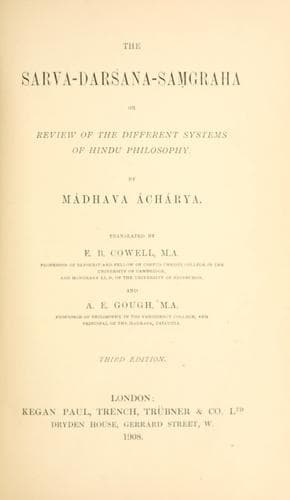
The Sarva-Darsana-Samgraha: Or, Review of the Different Systems of Hindu PhilosophyMadhava
ReligionEastern
The Sarva-Darsana-Samgraha: Or, Review of the Different Systems of Hindu Philosophy
Madhava
Philosophy, Hindu; Philosophy, Indic
(To recapitulate.) Existence is restricted to the momentary; there
being observed in regard to existence a negative rule, that in regard
to permanent succession and simultaneity being excluded, existence
which contains succession and simultaneity is not cognisable; and
there being observed in regard to existence a positive rule, in virtue
of a concomitance observed (viz., that the existent is accompanied or
"pervaded" by the momentary), and in virtue of a non-concomitance
observed (viz., that the non-momentary is accompanied or "pervaded" by
the non-existent). Therefore it has been said by Jñána-śrí--
"What is is momentary, as a cloud, and as these existent
things;
"The power of existence is relative to practical efficiency,
and belongs to the ideal; but this power exists not as
eternal in things eternal (ether, &c.);
"Nor is there only one form, otherwise one thing could do
the work of another;
"For two reasons, therefore (viz., succession and
simultaneity), a momentary flux is congruous and remains
true in regard to that which we have to prove."
Nor is it to be held, in acceptance of the hypothesis of the
Vaiśeshikas and Naiyáyikas, that existence is a participation in the
universal form existence; for were this the case, universality,
particularity, and co-inhesion (which do not participate in the
universal) could have no existence.
Nor is the ascription of existence to universality, particularity, and
co-inhesion dependent on any _sui generis_ existence of their own; for
such an hypothesis is operose, requiring too many _sui generis_
existences. Moreover, the existence of any universal is disproved by a
dilemma regarding the presence or non-presence (of the one in the
many); and there is not presented to us any one form running through
all the diverse momentary things, mustard-seeds, mountains, and so
forth, like the string running through the gems strung upon it.
Moreover (we would ask), is the universal omnipresent or present
everywhere in its subjicible subjects? If it is everywhere, all things
in the universe will be confounded together (chaos will be eternal),
and you will be involved in a tenet you reject, since Praśasta-páda
has said, "Present in all its subjects." Again (if the universal is
present only in its proper subjects), does the universal (the nature
of a jar) residing in an already existing jar, on being attached to
another jar now in making, come from the one to attach itself to the
other, or not come from it? On the first alternative (if it comes),
the universal must be a substance (for substances alone underlie
qualities and motions); whereas, if it does not come, it cannot attach
itself to the new jar. Again (we ask), when the jar ceases to exist,
does the universal outlast it, or cease to exist, or go to another
place? On the first supposition it will exist without a subject to
inhere in; on the second, it will be improper to call it eternal (as
Public-domain text, read in full here on John Shaqi.
The Sarva-Darsana-Samgraha: Or, Review of the Different Systems of Hindu Philosophy — John Shaqi
Reviews
Reviews
No reviews yet
Be the first to share your thoughts on this work.
Join the Discussion
Join the discussion
Sign in to leave a comment or review.
Sign InorCreate an account