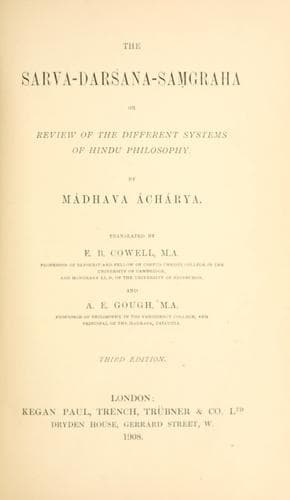
The Sarva-Darsana-Samgraha: Or, Review of the Different Systems of Hindu PhilosophyMadhava
ReligionEastern
The Sarva-Darsana-Samgraha: Or, Review of the Different Systems of Hindu Philosophy
Madhava
Philosophy, Hindu; Philosophy, Indic
you do); on the third, it will follow that it is a substance (or base
of qualities and motions). Destroyed as it is by the malign influence
of these and the like objections, the universal is unauthenticated.
Conformably it has been said--
"Great is the dexterity of that which, existing in one
place, engages without moving from that place in producing
itself in another place.
"This entity (universality) is not connected with that
wherein it resides, and yet pervades that which occupies
that place: great is this miracle.
"It goes not away, nor was it there, nor is it subsequently
divided, it quits not its former repository: what a series
of difficulties!"
If you ask: On what does the assurance that the one exists in the many
rest? You must be satisfied with the reply that we concede it to
repose on difference from that which is different (or exclusion of
heterogeneity). We dismiss further prolixity.
That all transmigratory existence is identical with pain is the common
verdict of all the founders of institutes, else they would not be
found desirous to put a stop to it and engaging in the method for
bringing it to an end. We must, therefore, bear in mind that all is
pain, and pain alone.
If you object: When it is asked, like what? you must quote an
instance,--we reply: Not so, for momentary objects self-characterised
being momentary, have no common characters, and therefore it is
impossible to say that this is like that. We must therefore hold that
all is like itself alone, like itself alone.
In like manner we must hold that all is void, and void alone. For we
are conscious of a determinate negation. This silver or the like has
not been seen by me in sleeping or waking. If what is seen were
(really) existent, then reality would pertain to the corresponding act
of vision, to the (nacre, &c.), which is the basis of its particular
nature (or haecceity), to the silver, &c., illusorily superposed upon
that basis, to the connection between them, to the co-inherence, and
so forth: a supposition not entertained by any disputant. Nor is a
semi-effete existence admissible. No one imagines that one-half of a
fowl may be set apart for cooking, and the other half for laying eggs.
The venerated Buddha, then, having taught that of the illusorily
superposed (silver, &c.), the basis (nacre, &c.), the connection
between them, the act of vision, and the _videns_, if one or more be
unreal it will perforce ensue that all are unreal, all being equally
objects of the negation; the Mádhyamikas excellently wise explain as
follows, viz., that the doctrine of Buddha terminates in that of a
total void (universal baselessness or nihilism) by a slow progression
like the intrusive steps of a mendicant, through the position of a
momentary flux, and through the (gradual) negation of the illusory
assurances of pleasurable sensibility, of universality, and of
reality.
Public-domain text, read in full here on John Shaqi.
Reviews
Reviews
No reviews yet
Be the first to share your thoughts on this work.
Join the Discussion
Join the discussion
Sign in to leave a comment or review.
Sign InorCreate an account