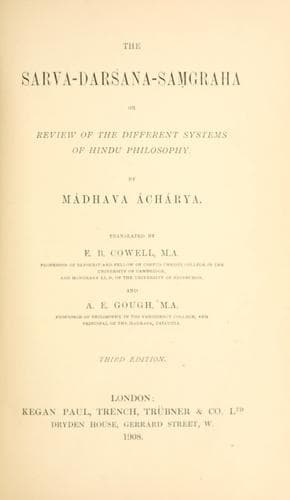
The Sarva-Darsana-Samgraha: Or, Review of the Different Systems of Hindu PhilosophyMadhava
ReligionEastern
The Sarva-Darsana-Samgraha: Or, Review of the Different Systems of Hindu Philosophy
Madhava
Philosophy, Hindu; Philosophy, Indic
The ultimate principle, then, is a void emancipated from four
alternatives, viz., from reality, from unreality, from both (reality
and unreality), and from neither (reality nor unreality). To exemplify
this: If real existence were the nature of a water-pot and the like,
the activity of its maker (the potter) would be superfluous.
If non-existence be its nature the same objection will accrue; as it
is said--
"Necessity of a cause befits not the existent, ether and the
like, for instance;
"No cause is efficacious of a non-existent effect, flowers
of the sky and the like, for instance."
The two remaining alternatives, as self-contradictory, are
inadmissible. It has accordingly been laid down by the venerated
Buddha in the Alaṅkárávatára[34]--
"Of things discriminated by intellect, no nature is
ascertained;[35]
"Those things are therefore shown to be inexplicable and
natureless."
And again--
"This matter perforce results, which the wise declare, No
sooner are objects thought than they are dissipated."
That is to say, the objects are not determined by any one of the four
alternatives. Hence it is that it has been said--
"A religious mendicant, an amorous man, and a dog have three
views of a woman's person, respectively that it is a
carcass, that it is a mistress, and that it is a prey."
In consequence, then, of these four points of view, when all ideas are
come to an end, final extinction, which is a void, will result.
Accordingly we have overtaken our end, and there is nothing to be
taught to us. There consequently remain only two duties to the
student--interrogation and acceptance. Of these, interrogation is the
putting of questions in order to attain knowledge not yet attained.
Acceptance is assent to the matters stated by the sacred teacher.
These (Bauddha nihilists) are excellent in assenting to that which the
religious teacher enounces, and defective in interrogation, whence
their conventional designation of Mádhyamikas (or mediocre).
Certain other Buddhists are styled Yogácháras, because while they
accept the four points of view proclaimed by the spiritual guide, and
the void of external things, they make the interrogation: Why has a
void of the internal (or baselessness of mental phenomena) been
admitted? For their technology is as follows:--Self-subsistent
cognition must be allowed, or it will follow that the whole universe
is blind. It has conformably been proclaimed by Dharmakírti: "To one
who disallows perception the vision of objects is not competent."
Public-domain text, read in full here on John Shaqi.
Reviews
Reviews
No reviews yet
Be the first to share your thoughts on this work.
Join the Discussion
Join the discussion
Sign in to leave a comment or review.
Sign InorCreate an account