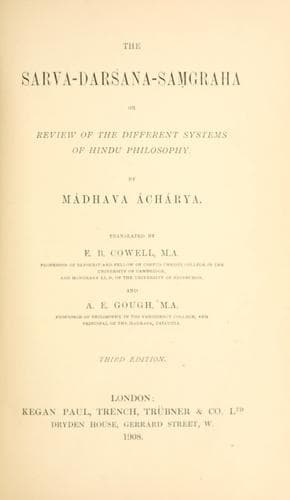
The Sarva-Darsana-Samgraha: Or, Review of the Different Systems of Hindu PhilosophyMadhava
ReligionEastern
The Sarva-Darsana-Samgraha: Or, Review of the Different Systems of Hindu Philosophy
Madhava
Philosophy, Hindu; Philosophy, Indic
An external _percipibile_ is not admissible in consequence of the
following dilemma. Does the object cognitively apprehensible arise
from an entity or not? It does not result from an entity, for that
which is generated has no permanence. Nor is it non-resultant, for
what has not come into being is non-existent. Or (we may proceed) do
you hold that a past object is cognitively apprehensible, as begetting
cognition? If so, this is childish nonsense, because it conflicts with
the apparent presentness of the object, and because on such a
supposition the sense organs (and other imperceptible things) might be
apprehended. Further (we ask), Is the _percipibile_ a simple atom or a
complex body? The latter it cannot be, this alternative being ejected
by the dilemma as to whether part or whole is perceived. The former
alternative is equally impossible, an atom being supersensible, and it
not being able to combine simultaneously with six others; as it has
been said--
"If an atom could simultaneously combine with six, it would
have six surfaces;
"And each of these being taken separately, there would be a
body of atomic dimension."
Intellect, therefore, as having no other _percipibile_ but itself, is
shown to be itself its own _percipibile_, self-subsistent, luminous
with its own light, like light. Therefore it has been said--
"There is naught to be objectified by intellect; there is no
cognition ulterior thereto;
"There being no distinction between percept and percipient,
intellect shines forth of itself alone."
The identity of percipient and percept is inferrible, thus: That which
is cognised by any cognition is not other than that cognition, as
soul, for instance, is not other than the cognition of soul; and blue
and other momentary objects are cognised by cognitions. For if there
were a difference (between percept and percipient), the object could
not now have any connection with the cognition, there being no
identity to determine a constancy of connection, and nothing to
determine the rise of such a connection. As for the appearance of an
interval between the object and subject consciousnesses, this is an
illusion, like the appearance of two moons when there is only one. The
cause of this illusion is ideation of difference in a stream without
beginning and without interruption; as it has been said--
"As invariably cognised together, the blue object and the
cognition thereof are identical;
"And the difference should be accounted for by illusory
cognitions, as in the example of the single moon."
And again--
"Though there is no division, the soul or intellect, by
reason of illusory perceptions,
"Appears to possess a duality of cognitions, of percepts and
of percipient."
Public-domain text, read in full here on John Shaqi.
Reviews
Reviews
No reviews yet
Be the first to share your thoughts on this work.
Join the Discussion
Join the discussion
Sign in to leave a comment or review.
Sign InorCreate an account